Best QMS software for medical devices: a comparison guide

April 28, 2026 ░░░░░░

Best QMS blog cover

Choosing a quality management system (QMS) is one of the most consequential infrastructure decisions a medtech company makes, and it's also one of the easiest to get wrong. Not because the options are hard to find, but because the wrong framing makes them hard to evaluate.

Most teams approach QMS selection as a compliance checkbox: what's the minimum system that keeps us out of trouble? That framing consistently leads to underinvestment early and expensive remediation later. The better question is what system will let your team build a compliant, submission-ready design history without adding administrative drag to an already stretched engineering team.

This guide breaks down the five categories of QMS solutions available to medical device companies today, explains what each one actually costs in practice, and helps you understand which type of system fits where you are in your development journey.

FREE DOWNLOAD: Click here to download your PDF copy of the Ultimate Guide to Comparing QMS Solutions for Medical Devices.

What to look for in a QMS: the evaluation criteria that actually matter

Before comparing solution types, it helps to agree on what a good eQMS actually needs to do for a medtech company. Most vendor demos lead with interface and feature counts, but that’s not always the best way to understand whether an eQMS is right for you. The criteria below are what determine whether a system actually works for your team six months after you've implemented it.

Regulatory alignment out of the box

Any QMS you use to manage quality records needs to reflect the current regulatory framework under the FDA's Quality Management System Regulation (QMSR) and ISO 13485:2016. The QMSR, which went into effect in early 2026, harmonized the longstanding FDA Quality System Regulation (QSR) with ISO 13485. While the practical effects of the change were not dramatic (the FDA already called ISO 13485 “substantially equivalent” with the old QSR), the system you implement should reflect current requirements from day one, not require you to build regulatory alignment yourself through configuration.

Pre-validated workflows

Any software used to manage quality records is subject to computer system validation (CSV) requirements. That validation burden varies significantly depending on the type of system you choose, and it's one of the most underappreciated costs in QMS selection. Before committing to a platform, understand exactly what validation work is required to get the system production-ready and what ongoing validation is required each time the system changes.

Bidirectional traceability

A QMS needs to maintain live, bidirectional traceability between user needs, design inputs, outputs, verification and validation, and risk records. Without it, your Design and Development File (DDF) will not hold together at submission. Many teams discover this gap at the worst possible moment, when they are assembling their records in the months before a 510(k) filing and realize the connections an FDA reviewer needs are not there.

Implementation speed

A 510(k) typically takes 18 to 36 months from working prototype to cleared device. A QMS that takes six months to implement is a meaningful fraction of that window. Understand the realistic timeline from kickoff to a system your team is actually working in before you commit.

Scalability without a platform switch

Switching QMS platforms mid-development means migrating documentation, revalidating the new system, and reconstructing traceability. That work is expensive and time-consuming at any stage. The system you choose now should be capable of supporting your quality needs through submission and into post-market, not just where you are today.

Comparing the best QMS solutions for medical devices

QMS solutions for medtech fall into five categories. Each has a real use case and real tradeoffs. Understanding where each one falls short helps you avoid the category of regret most common among teams that have already been through one QMS switch.

DIY and spreadsheets

When we refer to a DIY or spreadsheet-based QMS, we mean physical documents or the digital equivalent: Google Docs, Excel, SharePoint, Dropbox, or any combination of shared drives that function as a filing cabinet. These are where most pre-market teams start because the upfront cost is close to zero and the setup time is minimal.

The problem with DIY systems is not that they fail compliance requirements immediately. It's that they accumulate quality debt quietly. As your team grows, design iterations multiply and documentation naturally outgrows your ability to maintain it. By the time you recognize the problem, it's become systemic. Teams working from spreadsheets and shared drives routinely spend four to eight months in documentation cleanup before they can even begin submission prep.

QMS people, processes and data

There's also a compliance ceiling problem. Maintaining closed-loop traceability across design controls, changes, audits, corrective and preventive actions (CAPAs), and customer feedback is effectively impossible when your records are disconnected. Complying with 21 CFR Part 11 on electronic signatures requires either physical signatures or third-party software. And none of this gets easier as your device line grows.

DIY and spreadsheet pros:

  • Low initial cost to implement

  • Fast to get started

  • No training required

DIY and spreadsheet cons:

  • No built-in traceability across quality processes

  • Compliance risk grows with team size and design complexity

  • Significant engineering time consumed by manual documentation tasks

  • Difficult to scale without a platform migration

  • Audit preparation is manual, time-consuming, and unreliable

  • Cleanup always costs more than setup would have

Generic life sciences QMS software

Generic life sciences platforms are built for regulated industries broadly, with roots often in pharmaceutical or biotech compliance. They handle the fundamentals of document control, training management, and CAPA reasonably well, and for a pharma team they may be a natural fit. For a medical device company, particularly a pre-market one, they create friction at almost every step.

The core problem is that medtech quality requirements are structurally different from pharma quality requirements. Design controls, bidirectional traceability between requirements and risk, and Design and Development File management are not standard features in systems that weren't built around them. Getting those capabilities requires configuration, and configuration requires validation. The result is a system that takes months to stand up, requires ongoing consultant support to maintain, and still has gaps that push design and development activity outside the system.

For a pre-market team that needs to move fast and build a clean Design and Development File as it goes, a generic life sciences platform is a poor fit regardless of how capable it looks in a demo.

Generic life sciences QMS pros:

  • Covers document control and training management well

  • Familiar to teams coming from pharma or biotech backgrounds

  • Compatible with remote and hybrid teams

Generic life sciences QMS cons:

  • Not designed around medtech design controls or design history requirements

  • Requires significant configuration and validation before it's useful for device development

  • Teams often need external consultants to configure and maintain the system

  • Design and development activity frequently ends up happening outside the system

  • Long implementation timelines

Enterprise QMS platforms

Enterprise QMS platforms are built for large, established manufacturers with complex validation requirements, global quality operations, and dedicated IT and compliance teams to manage the system. They are comprehensive by design, covering every quality process from supplier management to post-market surveillance to manufacturing quality controls.

For the right buyer, that comprehensiveness is the point. A company managing multiple device lines across multiple markets with hundreds of employees in quality and operations has real reasons to invest in a platform that can handle that complexity.

For a pre-market team, enterprise platforms are the wrong tool for where you are. Implementation timelines are measured in months or years. Validation burden is significant. The workflows are built for the problems of a large, commercialized manufacturer, not for a lean team trying to build a traceable Design and Development File while simultaneously building a device. The cost of implementation, both in time and money, is substantial relative to the size and stage of most pre-market companies, and the system you stand up today will be heavily overbuilt for your current needs while potentially still requiring a migration when your actual post-market complexity arrives.

Enterprise QMS pros:

  • Comprehensive coverage of every quality process

  • Built for global compliance and multi-site operations

  • Strong audit trails and reporting for large organizations

Enterprise QMS cons:

  • Implementation timelines and validation burden are prohibitive for pre-market teams

  • Built for post-market manufacturing complexity, not pre-market development speed

  • High total cost of ownership relative to the needs of an early-stage company

  • Overbuilt for pre-market teams, often still requiring migration at commercialization

  • Requires dedicated IT and compliance resources to maintain

Modern upstarts

A newer category of QMS tools has emerged in recent years, built primarily for software as a medical device (SaMD) and software in a medical device (SiMD) companies. These platforms offer developer-friendly workflows, native integrations with tools like Jira and GitHub, and a lighter compliance footprint designed for software-first teams.

The appeal of these systems is real. For a pure SaMD team where engineers are the primary QMS users and the product lives entirely in software, a developer-native system lowers the friction between where work happens and where it gets documented.

The primary limitation is their scope. Modern upstart platforms are typically optimized for a subset of the QMS requirements that apply to medtech, particularly those most relevant to software development workflows. Teams will find gaps in areas like design verification and validation documentation, supplier management, and full CAPA and nonconformance (NC) infrastructure.

For companies that are pre-market today and expect to be post-market in two or three years, the narrower scope of these tools often requires a platform switch at the point where post-market quality processes become necessary, which means migration, revalidation, and traceability reconstruction at exactly the wrong time.

Modern upstart QMS pros:

  • Developer-native workflows and integrations (Jira, GitHub)
  • Low friction for software engineering teams
  • Fast setup and modern user experience

Modern upstart QMS cons:

  • Typically optimized for SaMD, not hardware or combination products
  • Limited support for full QMS processes like CAPA, supplier management, and post-market surveillance
  • May require a platform switch as post-market quality needs emerge
  • Narrower regulatory coverage outside software-specific requirements

Purpose-built QMS software

A purpose-built QMS is designed from the ground up for a single industry. For medtech, that means the regulatory frameworks, the workflows, and the traceability model are built in rather than added on as a customizable option. Instead of configuring a general system to meet your requirements, you're implementing a system where those requirements are already the architecture.

The practical difference shows up at implementation. A purpose-built system aligned with FDA QMSR and ISO 13485 arrives pre-validated, which eliminates the CSV burden that makes generic and enterprise platforms so costly to stand up. The workflows for design controls, risk management, change control, and document management reflect actual medtech regulatory expectations, which means your team spends its time doing the work rather than figuring out how to make the system accommodate the work.

The tradeoff here is customization. A system designed for medtech is not designed to be infinitely adaptable. It reflects a specific model of how a compliant medical device company operates, and that model won't suit every edge case. But for most pre-market medtech teams, the right question isn't whether the system is flexible. It's whether the system is right for the work, and whether you'll still be on it at submission and beyond.

Purpose-built QMS pros:

  • Built specifically for medtech and updated as regulations evolve
  • Pre-validated workflows reduce implementation time and CSV burden
  • Closed-loop traceability across design controls, risk, and quality events
  • FDA and ISO best practices built into every module
  • Single source of truth across quality and product development
  • Scales from pre-market development through post-market surveillance
  • Access to medtech-specific expertise and implementation support

Purpose-built QMS cons:

  • Not suited for industries outside medtech
  • Less customizable than generic or enterprise platforms
  • Higher upfront cost than DIY systems

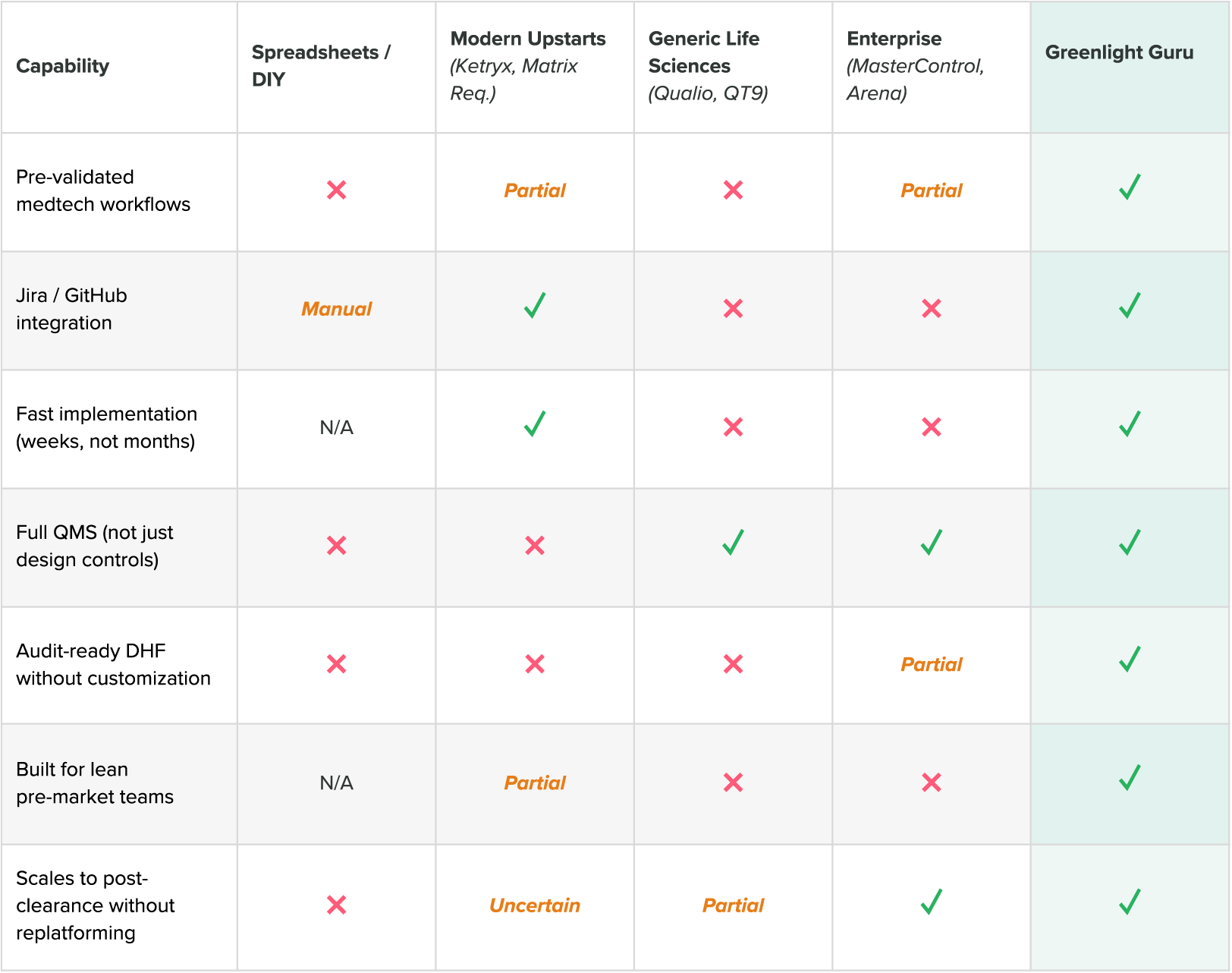
Here's a quick visual breakdown of all the categories, including Greenlight Guru, which is purpose-built for the medtech industry.

pg10

Best QMS software for different medtech companies

Greenlight Guru is used by more than 1,100 medical device companies across the globe, from early-stage startups building their first device to established manufacturers managing multiple product lines. Here's how that looks in practice.

Best QMS solution for scaling medical device companies

Puzzle Medical Devices, Inc. is striving to improve the quality of life with their device, ModulHeart, which provides a minimally invasive option for heart failure treatment. Since Puzzle’s device is Class III, it was critical they had a QMS that would keep them compliant while allowing them to move quickly and manufacture prototypes.

With Greenlight Guru, the team at Puzzle accelerated their go-to-market timeline by 5 months in the first year of using the QMS. They were also able to manufacture precise and high-quality prototypes in a fast-paced environment while maintaining compliance with regulations. 

Puzzle Medical Customer Story Greenlight Guru

Best QMS software for established companies selling devices internationally

The team at C2DX acquired a high-quality device (the STIC Intra-Compartmental Pressure Monitor System) from Stryker, but they needed to ensure that they could continue delivering the same quality from day one.

C2DX was started by MedTech industry veterans, and their extensive industry experience meant they knew the limitations of other QMS solutions, so when they started C2DX, they decided to implement a purpose-built QMS from the get-go.

That decision not only allowed them to pass audits with flying colors, it meant they had the post-market surveillance tools in place to monitor their product, react quickly to any issues, and continue growing. 

Passing MDSAP Audit & Getting FDA Approval Just Weeks After Implementing Medical Device Success Platform

Best QMS software for MedTech companies to stay audit ready

Monitored Therapeutics, Inc. (MTI) is a remote patient monitoring company with a focus on respiratory diseases. MTI sells their proprietary diagnostics products globally and needed an affordable QMS that would help them successfully navigate audits and manage post-market surveillance.

MTI chose Greenlight Guru. The intuitive and powerful QMS software, along with guidance from Greenlight’s industry experts, the Gurus, helped MTI pass six audits in one year, including ISO and MDSAP audits. As they continue to grow their product line, MTI knows that Greenlight Guru will be with them every step of the way. 

Monitored Therapeutics, Inc: Building an Audit-ready QMS in 3 MonthsLearn more about how we help our customers today →

How to evaluate your options: questions worth asking in every demo

The most useful QMS evaluation doesn't start with a feature checklist. It starts with understanding whether a given system actually delivers what a lean medtech team needs six months after implementation. These questions separate systems that were designed for medtech from systems that were adapted for it:

  • How much ongoing engineering time does your system require after implementation, week over week?

  • Can quality and product teams work in the same environment without a manual handoff between them?

  • How long does a standard implementation take from kickoff to audit-ready?

  • Walk me through what happens to our traceability records when we make a late-stage design change.

  • How does Design and Development File assembly work?

  • Can you show me how a Jira ticket connects to a design requirement?

A vendor that can answer those questions in a live product demonstration is a vendor whose system was built for the work. One that redirects to a roadmap or a configuration guide is one that's asking you to build for them.


FREE DOWNLOAD: Click here to download your PDF copy of the Ultimate Guide to Comparing QMS Solutions for Medical Devices.

The best QMS makes quality your competitive differentiator

The best medtech companies treat quality as a competitive advantage, rather than a compliance burden. A right-sized QMS gives your team the foundation to move faster, document cleaner, and walk into every investor conversation, regulatory interaction, and partnership discussion with confidence that your records will hold.

The wrong system does the opposite. It creates drag where your team should have momentum. It generates cleanup work at exactly the stages when you can least afford it. And it forces the kind of platform decisions mid-development that cost months, not weeks, to resolve.

The QMS decision rarely feels urgent in the earliest stages of development, but that's precisely when it matters most. Teams that build a solid quality foundation early spend that investment once. Teams that defer it pay for it repeatedly, in engineering hours, in delayed submissions, and in the kind of audit findings that follow a product into the market.

So, if you’re ready to see how a purpose-built QMS software can help you pass audits, grow your business, and get your devices into the hands of the patients who need them most, then get your free demo of Greenlight Guru today!

Etienne Nichols is the Head of Industry Insights & Education at Greenlight Guru. As a Mechanical Engineer and Medical Device Guru, he specializes in simplifying complex ideas, teaching system integration, and connecting industry leaders. While hosting the Global Medical Device Podcast, Etienne has led over 200...

Greenlight Guru Value Calculator
Get a Customized Report ➔
ROI_Slide-In-CTA
Search Results for:
    Load More Results