What Is eQMS? Electronic Quality Management System Definition
An eQMS — electronic quality management system — is software that runs a company's quality processes in one connected system: document control, change control, training, audits, supplier quality, risk management and CAPA. In regulated industries it replaces the paper binders and spreadsheets those processes used to live in, and produces the controlled records, electronic signatures and audit trails that regulators expect to see
The primary goal of an eQMS is to ensure that an organization adheres to the required industry standards and regulatory requirements, including applicable FDA regulations, ISO standards, and 21 CFR Part 11 requirements for electronic records and signatures, while continuously improving the quality of their products.
QMS vs eQMS: What’s the Difference?
A quality management system is the overall framework a company uses to manage quality. It includes procedures, responsibilities, processes, records, and controls.
An eQMS is the electronic software platform used to manage those QMS activities digitally.
|
Term
|
Meaning
|
Example
|
|
QMS
|
The quality system itself
|
Procedures, responsibilities, quality records, training requirements, CAPA process
|
|
eQMS
|
Software used to manage the QMS electronically
|
Digital document control, electronic signatures, audit trails, CAPA workflows, training assignments
|
A company can have a QMS without an eQMS. For example, a QMS may be managed with paper binders, spreadsheets, and shared folders. But as quality processes become more complex, many medical device companies move to an eQMS to improve traceability, version control, visibility, and compliance.
Why should MedTech switch to eQMS?
Medical device manufacturers and other life sciences organizations have moved steadily away from paper-based quality management systems toward eQMS platforms that manage regulatory compliance, product quality and connected quality processes across the organization.
An eQMS helps medical device teams:
- Keep controlled documents current and accessible
- Route reviews and approvals electronically
- Maintain audit trails and version history
- Connect CAPA, complaints, nonconformances, changes, and training
- Improve visibility across quality and product development
- Support compliance with applicable regulatory requirements
- Reduce manual tracking and duplicate work
Medical device manufacturers that wish to market their products for sale in the United States are required by the FDA to comply with the quality management regulations set forth in 21 CFR Part 820. These regulations establish detailed quality management requirements for medical device manufacturers that address the need for documented design controls, corrective and preventive action procedures (including change control, document control, risk management, training records, and Design and Development File documentation), and a host of other quality processes that ensure medical devices are safe and effective for the intended user.
Paper-based systems remain common, particularly among smaller manufacturers — and they are the riskiest way to manage medical device projects . For this reason, an increasing number of medical device companies are adopting electronic quality management systems, or eQMS, to support their compliance with the FDA and ensure that newly designed medical devices are safe and effective for the intended user.
The Shift Away from Paper-Based QMS
Across the world, industries are undergoing digital transformation, applying new software applications and technologies to conduct business in new, more efficient ways. In the past, medical device companies employed an assortment of filing cabinets and server folders to manage quality system paperwork. While some medical device manufacturers are successful at employing paper-based QMS, there are several reasons why manufacturers are increasingly switching to eQMS and away from paper-based systems.
1. Missing documents
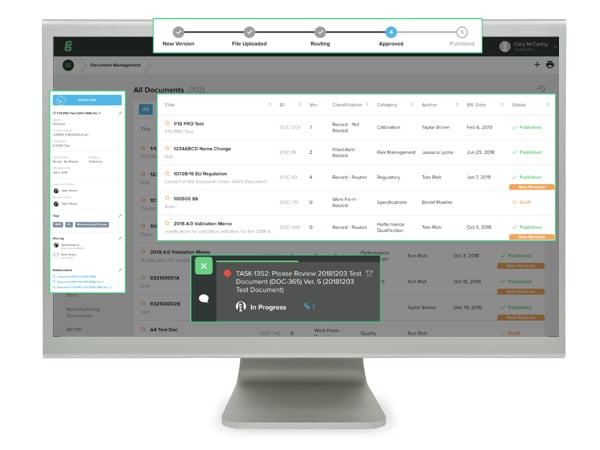
An eQMS centralizes document management so teams can see at a glance which records exist, which are current, and which are missing — before an auditor asks.
2. Missing signatures
FDA requirements call for document reviews, approvals, and re-approvals when changes are made. An eQMS helps manage signatures, approvals, and audit trails in a more efficient, compliant way.
3. Lack of document controls
Medical device companies must control documents to meet FDA requirements, including keeping approved, up-to-date versions available where needed. An eQMS helps by managing version control, approvals, and related workflows so teams stay compliant and audit-ready.
Paper-Based QMS vs eQMS
A paper-based QMS can work for very small teams, but it becomes harder to manage as products, processes, suppliers, and regulatory obligations grow. An eQMS gives teams a more controlled way to manage quality records and regulated workflows.
|
Paper-Based QMS Challenge
|
How an eQMS Helps
|
|
Missing or misplaced documents
|
Centralizes quality documents in one digital system
|
|
Outdated document versions
|
Maintains version history and controlled access to current documents
|
|
Missing signatures
|
Routes approvals and captures electronic signatures
|
|
Slow change control
|
Automates review, approval, and training impact workflows
|
|
Difficult audit preparation
|
Keeps records, audit trails, and approval history easier to access
|
|
Disconnected CAPA records
|
Links CAPA to complaints, nonconformances, changes, risks, and documents
|
|
Limited visibility
|
Gives teams a clearer view of open tasks, overdue items, and quality trends
|
Key Quality Processes Managed in an eQMS
An eQMS helps medical device companies manage the connected quality processes that support product quality and regulatory compliance. These processes often include document management, change management, change control, training management, supplier management, audit management, corrective action, CAPA management, risk management, and design history file management.
Instead of managing these activities in disconnected spreadsheets, shared drives, or paper files, an eQMS creates a centralized system where quality teams can maintain visibility into required tasks, approvals, documentation, and records. This is especially important for medical device and life sciences companies that need to demonstrate compliance with FDA regulations, 21 CFR Part 11, applicable ISO standards, and quality system requirements such as ISO 13485.
What Should an eQMS Include?
A medical device eQMS should support the quality processes and records that regulated teams need to manage throughout the product lifecycle.
Common eQMS capabilities include:
|
eQMS Capability
|
What It Helps Manage
|
|
Document control
|
SOPs, forms, policies, work instructions, version history, reviews, approvals
|
|
Change control
|
Change requests, impact assessments, approvals, implementation tasks, training impact
|
|
Training management
|
Role-based training, training records, overdue assignments, retraining
|
|
CAPA management
|
Investigations, root cause analysis, corrective actions, preventive actions, effectiveness checks
|
|
Nonconformance management
|
Product or process issues, containment, investigation, disposition, approvals
|
|
Supplier quality
|
Supplier qualification, supplier documentation, supplier audits, supplier monitoring
|
|
Audit management
|
Internal audits, supplier audits, findings, follow-up actions, audit evidence
|
|
Risk management
|
Risk files, risk controls, design links, review activities
|
|
Design controls
|
User needs, design inputs, outputs, verification, validation, and Design and Development File traceability
|
|
Electronic signatures
|
Controlled approvals and sign-offs for regulated records
|
|
Audit trails
|
Time-stamped records of actions, approvals, changes, and version history
|
How an eQMS Supports Regulatory Compliance
Regulatory compliance depends on more than simply storing quality documents. Medical device companies need documented, repeatable processes for approving changes, assigning training, managing suppliers, documenting corrective action, and preparing for audits.
An eQMS supports regulatory compliance by helping teams maintain controlled records, approval histories, electronic signatures, audit trails, and connected quality data. For companies subject to 21 CFR Part 11, an eQMS can help support requirements related to electronic records and electronic signatures. For companies aligning with ISO 13485 or other ISO standards, an eQMS can help demonstrate consistent quality processes, continuous improvement, supplier oversight, and product quality controls.
Why Change Control, CAPA, and Risk Management Matter
Quality processes do not exist in isolation. A design change may require a risk assessment, document updates, new training assignments, supplier review, and updates to the Design and Development File. A customer complaint may lead to a corrective action or formal CAPA management process. An audit finding may trigger change control or updates to procedures.
An eQMS helps connect these activities so teams can understand how one quality event impacts another. This improves visibility, strengthens audit readiness, and helps medical device companies maintain product quality throughout the product lifecycle.
Greenlight Guru's eQMS Supports FDA Compliance
Greenlight Guru's eQMS software built specifically for the compliance and quality assurance needs of the medical device industry. Greenlight Guru was designed for out-of-the-box, 1-to-1 compliance with the most current regulatory requirements for medical device companies:
Greenlight Guru is built for the regulatory requirements medical device companies actually operate under: FDA's Quality Management System Regulation (QMSR), which took effect on 2 February 2026 and incorporates The FDA QSR (21 CFR Part 820) and ISO 13485: 2016.
In addition to supporting compliance, Greenlight Guru eQMS software helps medical device companies manage workflows, reduce risk and improve time to market. Medical device companies can use Greenlight Guru to better align their processes, establish linkages between user needs, design outputs and known sources of risk, and easily produce documented evidence of effective quality practices.
Greenlight Guru's eQMS software serves as a single source of truth for your medical device company, so all required quality system documentation lives in one platform, securely stored in the cloud, and that the newest versions are instantly accessible by all persons with access to the system - that means automated document controls and no more missing documents.
Does an eQMS support EU MDR and other markets?
Most medical device companies sell into more than one market, and an eQMS has to hold up in all of them.
In the United States, that means FDA's Quality Management System Regulation (QMSR), which took effect on 2 February 2026 and incorporates ISO 13485:2016 by reference, plus 21 CFR Part 11 for electronic records and signatures. In the European Union, it means the Medical Device Regulation (MDR) — or the IVDR for in vitro diagnostics — where conformity is typically demonstrated through an ISO 13485:2016 quality system assessed by a notified body.
Because ISO 13485:2016 underpins both, most manufacturers run a single quality system rather than one per market, layering the market-specific requirements on top. An eQMS makes that practical: the same controlled documents, CAPAs, supplier records and audit trails serve every submission, rather than being maintained in parallel.
Frequently Asked Questions
What quality processes can an eQMS manage?
An eQMS can help medical device companies manage document management, training management, supplier management, audit management, change management, change control, corrective action, CAPA management, risk management, and design and development file documentation in a centralized quality system.
How does an eQMS support FDA's QMSR?
FDA's Quality Management System Regulation (QMSR) took effect on 2 February 2026, replacing the older Quality System Regulation in 21 CFR Part 820 and incorporating ISO 13485:2016 by reference. An eQMS supports it the same way it supports ISO 13485 — by maintaining controlled documents, change control, CAPA, supplier records, training assignments and audit trails as connected, time-stamped records that can be produced as objective evidence during an inspection.
How does an eQMS support 21 CFR Part 11?
An eQMS can support 21 CFR Part 11 by helping companies manage electronic records, electronic signatures, approval workflows, access controls, and audit trails. These capabilities help medical device companies maintain reliable quality records and demonstrate regulatory compliance.
Does an eQMS help with ISO 13485 and ISO standards?
Yes. An eQMS can help companies align quality processes with ISO 13485 and other applicable ISO standards, such as ISO 14971, by supporting document control, training records, supplier oversight, corrective action, internal audits, and continuous improvement.
Why is CAPA management important in an eQMS?
CAPA management helps medical device companies document, investigate, and resolve quality issues. In an eQMS, CAPA can be connected to complaints, audits, nonconformances, risk management activities, and corrective or preventive action records.
How does an eQMS support the Design and Development File?
An eQMS can help medical device companies maintain a complete Design and Development File by connecting design controls, risk management, document approvals, design changes, and product development records in one system.
Related Links