What comes after launch? A guide to post-market maturity
.png?width=800&height=400&name=What%20comes%20after%20launch%20A%20guide%20to%20post-market%20maturity%20(1).png)
Getting to market is a milestone most pre-market teams have been working toward for years. Then the moment comes, all your hard work pays off, and your product finally has market access. But the work doesn’t stop or settle down. Instead, it changes.
Pre-market work is milestone-driven. Every sprint, every design review, every submission step is organized around a single goal: get the device to market. The operating model is built for that, but once the device is on the market, that model stops fitting the work.
Post-market work is continuous. Complaints land in inboxes. Products need changes. Customers ask questions that turn into investigations. The regulatory bar keeps moving. And none of this comes with a handbook for how a team is supposed to do it all while also growing the business.
The uncertainty that most teams feel in the first year on the market isn't a sign that something is wrong. It's a predictable outcome of the change from design and development to managing a product on the market. What varies is how long teams stay in that uncertainty before they build enough structure to operate intentionally rather than reactively.
Launch is a shift in how the team works, not a finish line. Operating in-market requires a different way of working than getting to market, and most teams aren't warned about that in advance.
This guide exists to name the stages that teams go through once they have market access, describe what each one looks like in practice, and offer a practical path forward. The goal is to replace uncertainty with clarity, help you identify where you are, and give you a concrete picture of what good looks like from here.
Because teams who know their stage can act to improve their situation. Teams who don't tend to keep reacting to whatever showed up this week.
BONUS RESOURCE: Click here to download your free complaint log and form template bundle!
Table of contents
The four stages of post-market maturity
Every post-market medtech team is somewhere on this curve. The stages describe how quality systems actually operate in practice, not as a compliance benchmark, but as a day-to-day reality. You don’t have to reach Stage 4 overnight, but you should be able to honestly identify where you are now and the steps you need to take to move forward.
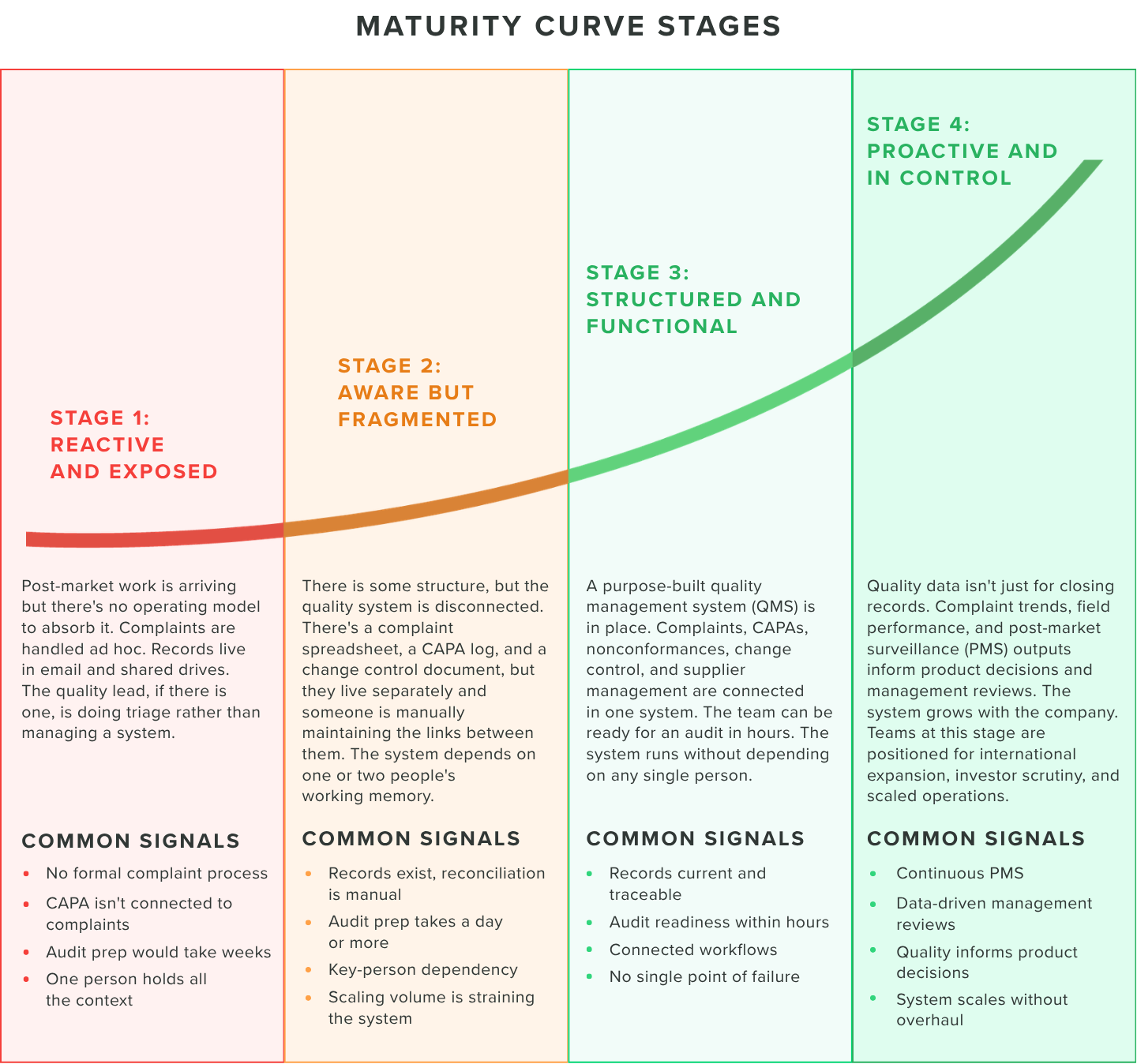
Most early post-market teams are at Stage 1 or 2 without realizing it. The system feels like it's working because the volume hasn't exposed its limits yet. That changes as the customer base grows.
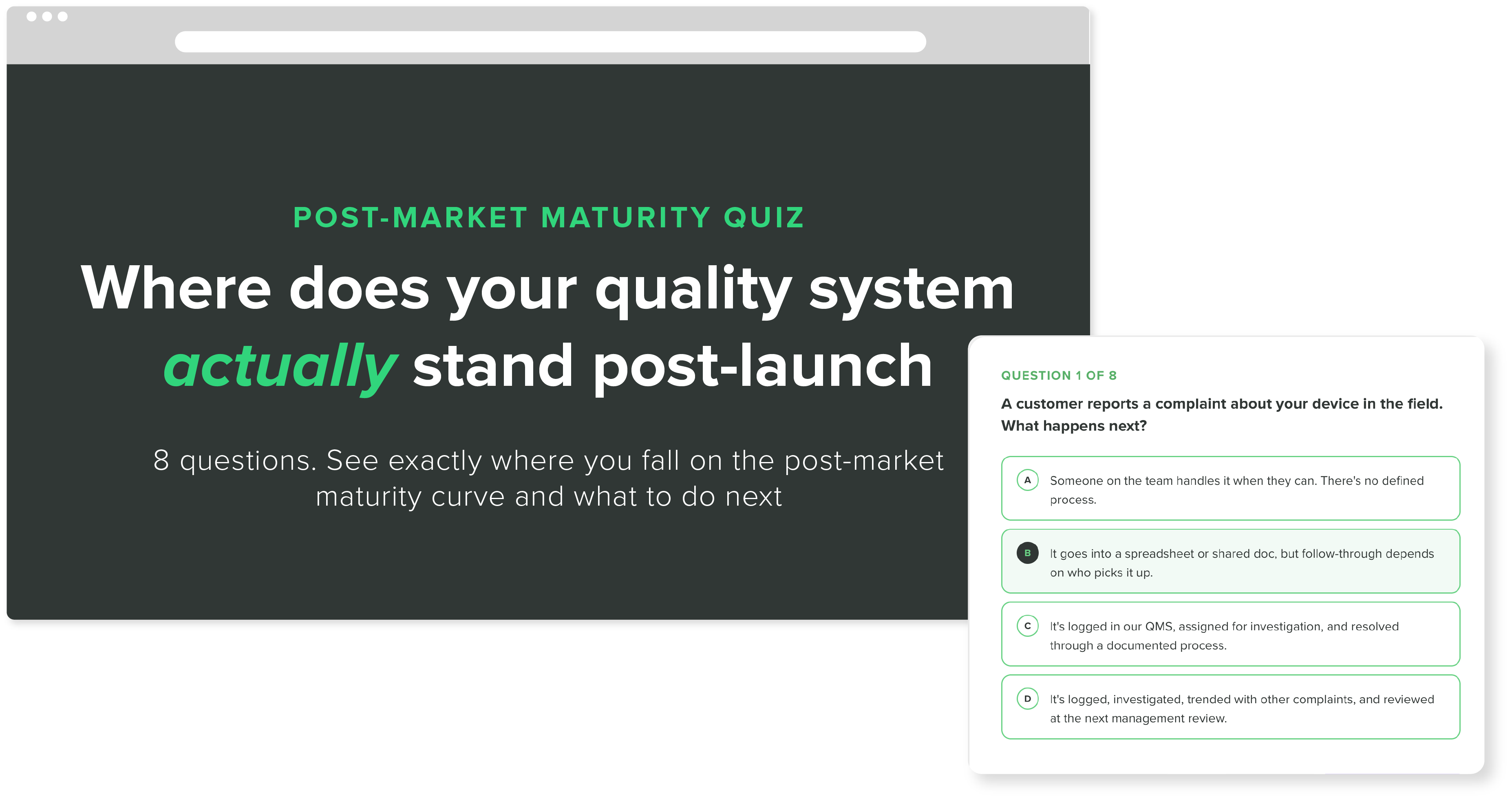
Not sure where you land? Try taking our 7 question post-market maturity quiz. It covers complaint handling, audit readiness, change control, CAPA, training, PMS, and scalability, and gives you a stage result with specific next steps.
Stage 1: Reactive and exposed
This is where most teams are in their first year on the market. The quality infrastructure that got them through submission was organized around that goal. Post-market work is different, and it didn't come with a matching system.
What work looks like at this stage
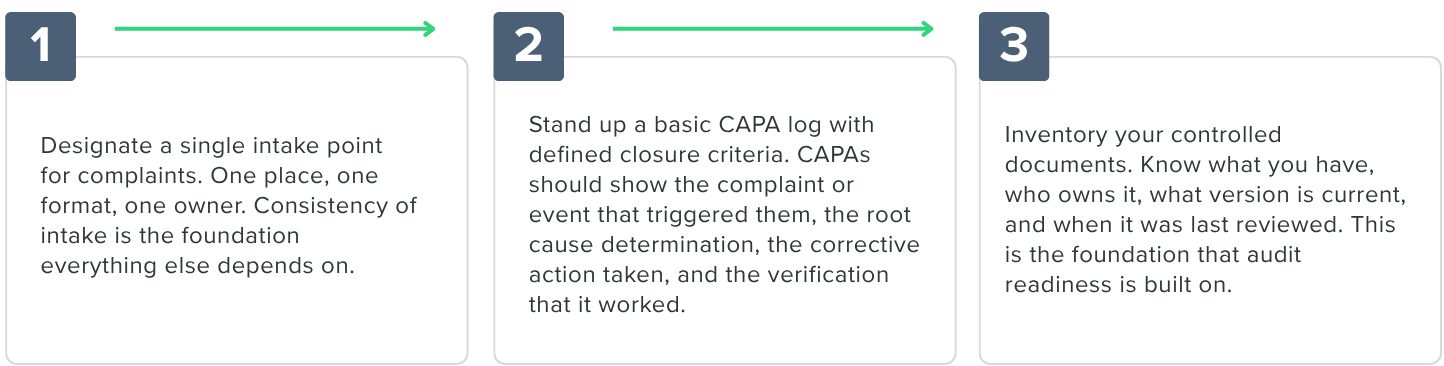
Complaints arrive without a clear process for receiving, investigating, or closing them. A customer reports a field issue and someone handles it, but the record of how it was handled, what was found, and what was done about it exists only in email. The CAPA process may not exist at all, or may be informal decisions made in Slack conversations.
Change control happens informally. Product changes are communicated, but the documentation trail doesn't consistently show who approved what or when. If a design review requires a view of the change history, someone has to reconstruct it manually.
Training is undocumented. The quality lead knows who has been trained on what because they were in the room. There's no system record.
This stage feels manageable because the volumes are still low. The risk is invisible until it surfaces as a complaint that isn’t escalated quickly enough, an audit with multiple findings, or a field event that requires a clear investigation trail that doesn't exist.
The real cost of Stage 1
Stage 1 teams may think they’re saving money on their quality system, but they’re really paying a huge price. The team is disorganized and spending time on manually maintaining documentation and chasing signatures. Organizational knowledge that keeps everything running lives in one or two people’s heads rather than any transferable record.
According to published FDA annual quality system data, CAPA-related deficiencies are the single most frequently cited issue in 483 observations year after year, and complaint handling is consistently in the top three. Both of those are directly tied to the informal systems that Stage 1 teams are running.
What's at risk under QMSR
The FDA's Quality Management System Regulation (QMSR), effective February 2026, allows inspectors to ask for documentation of management reviews, internal audits, and supplier audits, all of which used to be off-limits. Records assembled retroactively for an inspection don't carry the same weight as records maintained in a living system throughout the year.
The signal that you're at Stage 1: when a complaint arrives, the first question your team asks is "where do we put this?" Not "what's our process for this?"
Stage 2: Aware but fragmented
Stage 2 teams recognize the problem and have started building structure. The challenge is that the pieces aren't connected. Records exist, but someone is maintaining the links manually, and that person essentially is the system. Teams at this stage know there are issues, but often hold off on the true fix (a connected eQMS) because they’re worried about a difficult migration.
What work looks like at this stage
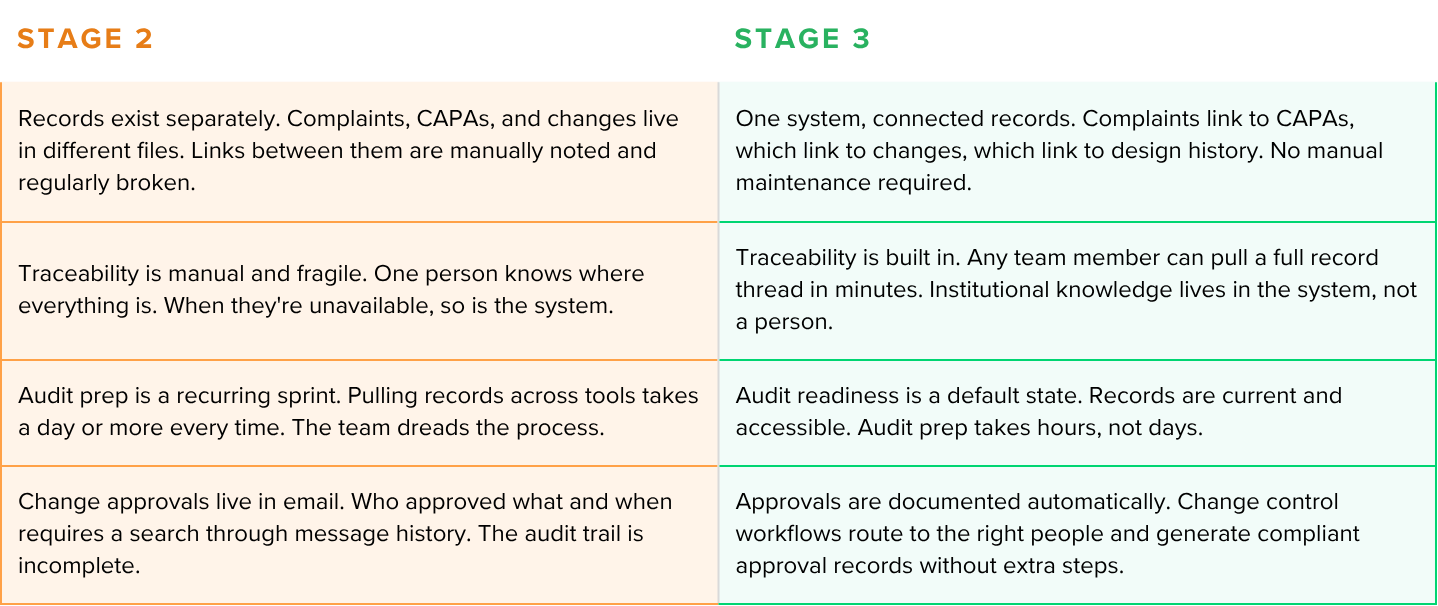
There are spreadsheets for complaints and CAPAs and nonconformances, and there’s a change control document. Each of these exists because someone on the team identified the gap and built something to fill it. The issue that remains is the connection between them all of them.
When a complaint leads to a CAPA, that connection is noted manually. When a CAPA leads to a design change, the link is maintained by whoever owns the CAPA log. When that person is on vacation, or leaves the company, the thread breaks.
Preparing for an audit at Stage 2 takes a day or more. Pulling records from multiple locations, reconciling versions, confirming that the narrative across all those disconnected documents actually holds together. It's doable, but it’s also a sprint every time.
The team may be thinking about a solution to their problems, but inertia and a fear of an overwhelming implementation and migration are holding them back from purchasing a new eQMS.
The key-person dependency problem
Stage 2 is where teams have a false sense of security. They have records, they have processes, and they've invested effort in building structure. What they often don't see is how fragile that structure really is.
When the person who built and maintains the system leaves, or is unavailable for an extended period, the quality system doesn't run on its own. The records exist, but the context that connects them, knowing which version is current, which CAPA closed which complaint, which change was reviewed in which design session, lives in someone's head.
The signal that you're at Stage 2: you could pass an audit if you had two weeks to prepare. You're not confident you could pass one with two days' notice.
Stage 3: Structured and functional
Stage 3 is where post-market operations stop feeling reactive and start feeling like a system. Complaint management, CAPA, change control, supplier management, and training are connected in a purpose-built QMS. Records are current. Traceability is built in. The system runs without depending on any one person.
What work looks like at this stage
In this stage, complaint intake follows a defined process. A complaint arrives, gets logged in the QMS, triggers an investigation workflow, and is assigned with a documented resolution path. If the complaint results in a CAPA, it’s linked automatically with no manual notation required. When a CAPA leads to a design change, that change flows through a connected change control process that links back to the original complaint and the design history.
Management reviews happen on a schedule and are always documented. Internal audits are planned, not reactive. Supplier oversight is structured. Training records are tied to procedures and triggered automatically when documents are updated.
If an inspector arrived tomorrow, the team would need hours, not days, to produce a complete, current, and traceable record of post-market operations.

The Stage 3 ceiling
Teams at Stage 3 are well-positioned with a solid quality system. The risk of an audit catastrophe is low. But there's a ceiling that shows up for teams who stop investing after reaching this stage.
The data exists in the system, but it isn't being used to drive decisions. Complaints are closed, but they aren’t trended. CAPAs are resolved, not analyzed for patterns. Management reviews are document exercises rather than data-driven conversations and post-market surveillance is periodic and retrospective rather than continuous and forward-looking.
That gap between functional and proactive matters more as the product matures, the customer base grows, and the business faces the kind of scrutiny that comes with scale: Series B due diligence, international market expansion, or commercial acquisition.
The signal that you're at Stage 3: you could pass an audit if you had two weeks to prepare. You're not confident you could pass one with two days' notice.
Stage 4: Proactive and in control
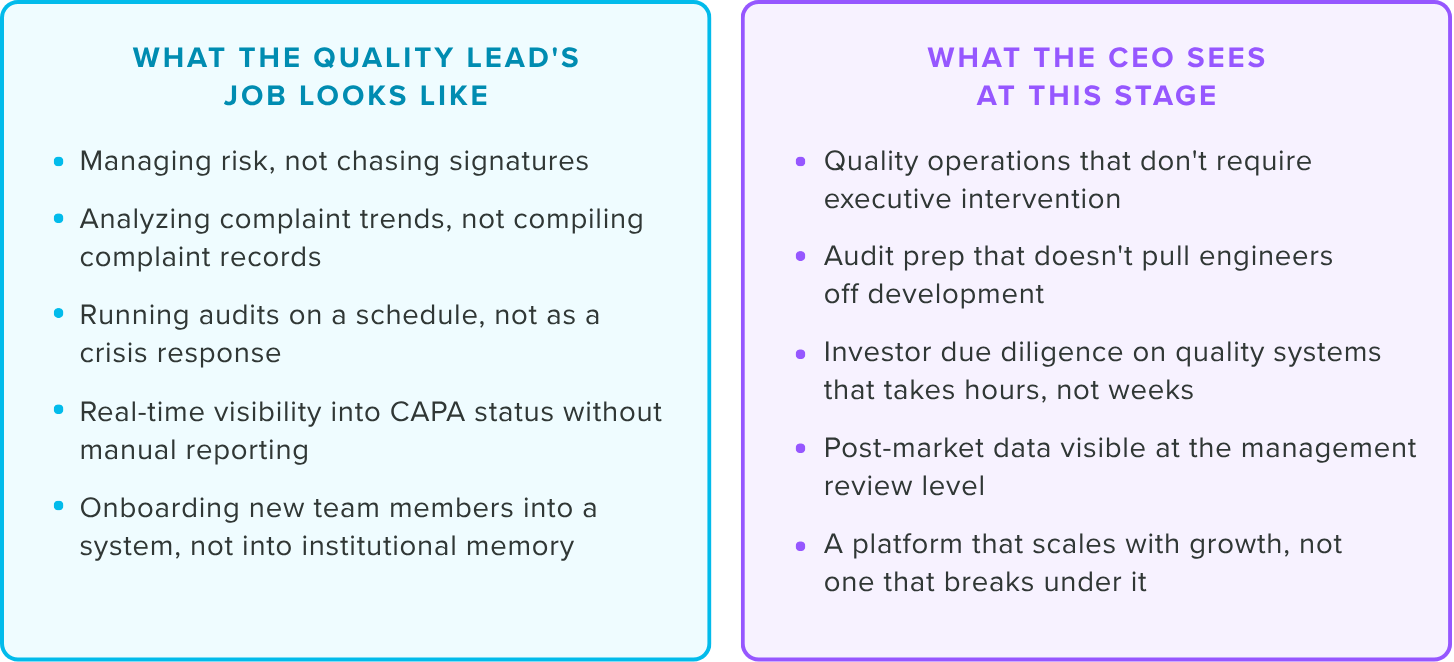
Stage 4 is the operating model that early post-market teams should be building toward. In this stage, quality data isn't just for compliance records. It informs product decisions, management reviews, and growth strategy. The quality system grows with the company.
What work looks like at this stage
In Stage 4, post-market surveillance is continuous, not periodic. Complaint data, adverse event patterns, and field performance trends are reviewed on a rolling basis, not assembled once a year for a scheduled review. Management reviews are built on operational metrics, complaint resolution rates, CAPA closure times, and supplier performance data, rather than on document reviews and status updates.
The quality system has been maintained consistently from early post-market through the current stage, so the data in it is longitudinal. Trends are visible over months and years, not just within the current quarter. New team members onboard into the system rather than going through institutional knowledge transfers.
Why Stage 4 matters for growth-stage companies
Teams preparing for Series B funding, international market access, or a commercial acquisition will have their post-market operations scrutinized by both investors and regulatory bodies. The questions that arise in those conversations (What's your complaint rate over the past 12 months? How are you managing field changes? What does your PMS infrastructure look like?) require data that a living, connected system provides and that a manual or fragmented one can't produce quickly or credibly.
Stage 4 operations are an asset, not just a compliance function. They signal operational maturity to investors and acquirers. They support international regulatory submissions and they demonstrate the kind of organized, data-driven quality culture that serious commercial growth requires.
The signal that you're at Stage 4: you use post-market data to make product and regulatory decisions, not just to close compliance records.
How to move up the curve
Teams don't move up the maturity curve by accumulating time in-market. They move by making specific structural decisions at the right moments.
Stage 1 to Stage 2: consolidate before you connect
The first move is getting complaint intake, CAPA tracking, and change control into consistent, documented formats, even if those formats are still spreadsheets. The goal is to establish ownership and process before you solve the connection problem. You can't connect records that don't exist yet.
Stage 2 to Stage 3: replace coordination with structure
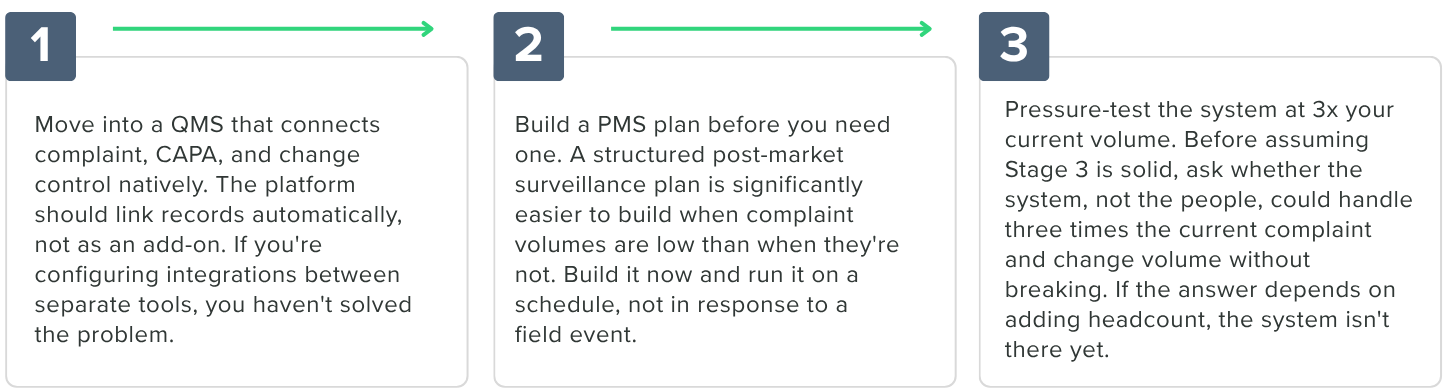
This transition is about eliminating the manual work of linking records and removing the single-person dependency that Stage 2 creates. It typically requires a purpose-built QMS, not because spreadsheets can't hold the data, but because they can't enforce the connections, the workflows, or the audit trail automatically.

Stage 3 to Stage 4: shift from record-keeping to signal reading
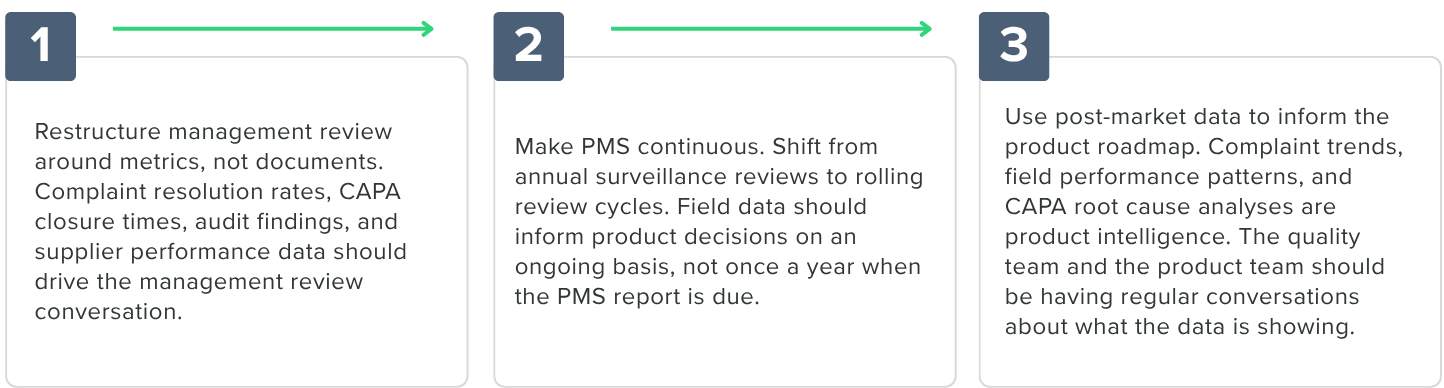
This transition is more a practice change than a tool change. The system you built to reach Stage 3 is capable of supporting Stage 4 operations. What has to shift is how the team uses the data it's already generating,

Where are you on the curve?
The 7-question maturity quiz maps your current operations to a specific stage and gives you tailored next steps, not a generic recommendation. See where you land!
Where Greenlight Guru fits
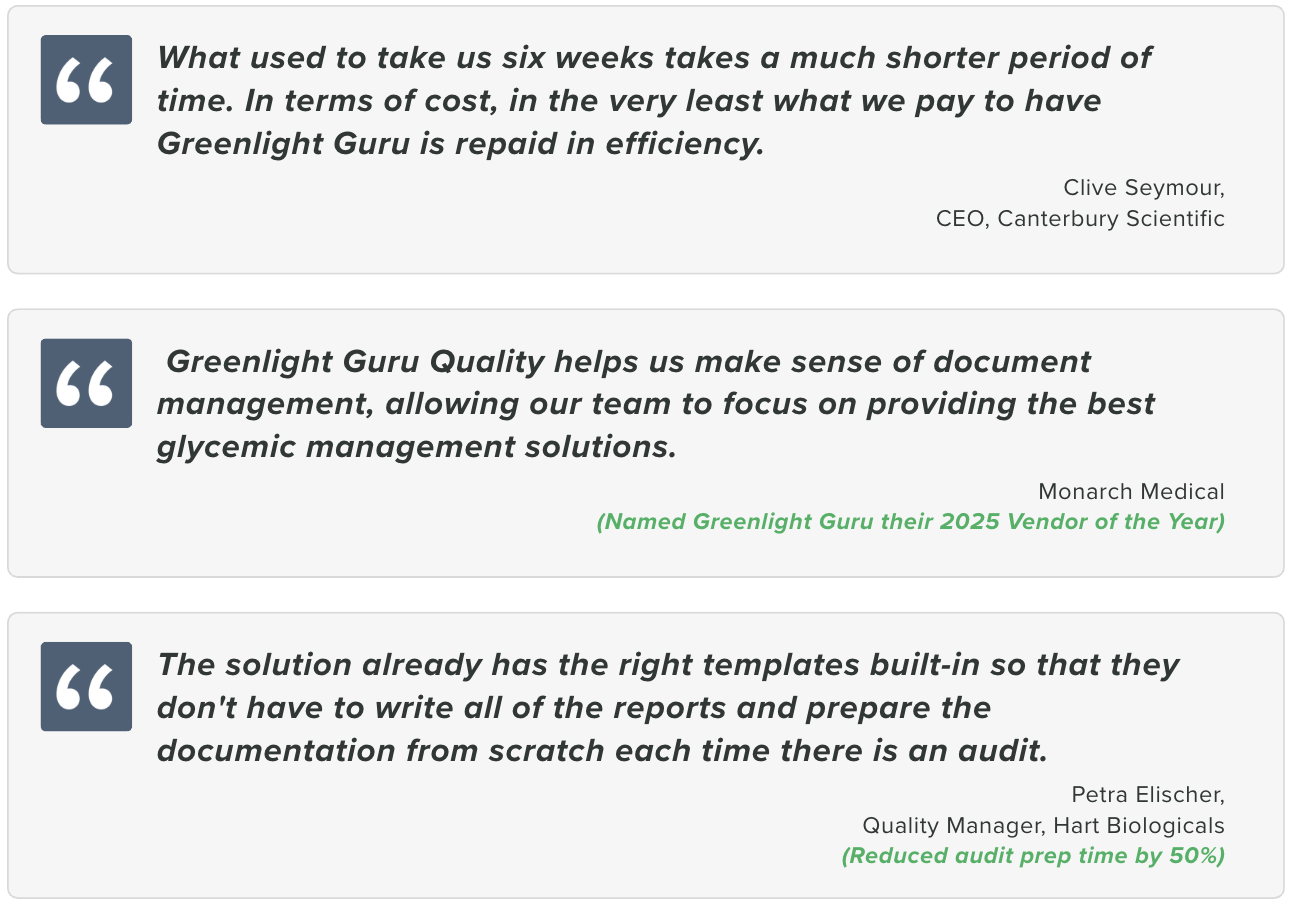
The most common concern we hear from early post-market teams evaluating a QMS isn't cost. It's disruption. Teams already have a quality system they’ve built themselves and they don't want to start over. That concern is worth taking seriously, and it's also why Greenlight Guru is designed the way it is.
Most quality platforms put the burden of setup on you. You get a blank system and a configuration guide, and then you spend months building workflows, mapping processes to regulations, and validating everything before you can use it. Greenlight Guru works differently on both counts.
Greenlight Guru can be configured by a single qualified person and is live in weeks, not quarters. There's no IT involvement, no lengthy validation project, and no period where your quality team is consumed by setup before any real work gets done. Your team is working in the system while teams on other platforms are still waiting for their implementation kickoff.
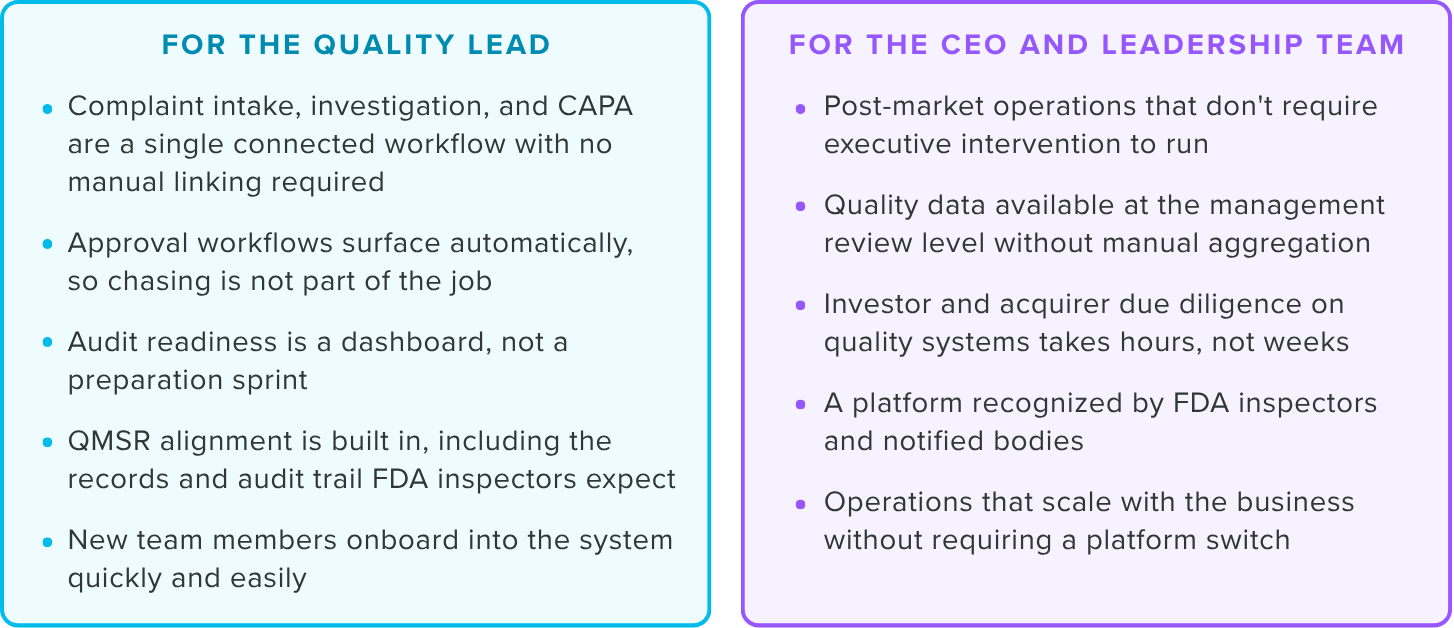
On top of that, the workflows, terminology, and compliance structure are already built for medtech on day one. Complaint handling, CAPA, change control, supplier management, training, and management review are connected by design and structured the way regulators expect to see them, aligned to FDA QMSR, ISO 13485, and MDR out of the box. You're not building that framework because it’s already there.

What customers say

A note on implementation
The concern that implementation will be the bottleneck is based on reasonable prior experience with the wrong systems. Enterprise QMS deployments can take months and require dedicated IT resources. Greenlight Guru can be configured by a single qualified person, with implementation support that moves from kickoff to live in weeks instead of months. The earlier a team makes the move, the less documentation has to be migrated or rebuilt.
Teams that implement earlier don't slow down. They stop accumulating the documentation debt that creates the real slowdown.
BONUS RESOURCE: Click here to download your free free complaint log and form template bundle!
Ready to move up the curve?
Most post-market teams don't struggle because they lack commitment to quality. They struggle because the tools they're using weren't built for this work. Spreadsheets break down as complaint volumes grow and manual coordination between quality and product teams costs time that nobody has to spare.
Greenlight Guru is purpose-built for post-market medtech operations. It comes with dedicated, connected modules for complaint management, CAPA, nonconformances, change control, supplier management, and training, all structured to meet FDA QMSR, ISO 13485, and MDR requirements on day one. There's no blank system to configure, no consultant required to map your processes to regulations, and no lengthy implementation before your team can do real work.
And because the system is designed for the full device lifecycle, you won't outgrow it. Whether you're managing your first complaints, preparing for international market access, or heading into a Series B, Greenlight Guru grows with the business without requiring a platform switch.
If you're ready to move from reactive to in control, get your free demo of Greenlight Guru today.
Elizabeth Weddle leads product marketing at Greenlight Guru, where she focuses on understanding market shifts and customer needs - translating those insights into strategy. With more than a decade of experience driving go-to-market strategy, she helps organizations navigate change and deliver solutions that drive...
Related Posts
The Ugly Truth About Managing Design Controls on Spreadsheets
Ultimate Guide to Supplier Management for Medical Device Companies
Ultimate Guide to Postmarket Surveillance of Medical Devices
Get your free download
Complaint Log + Form Template Bundle