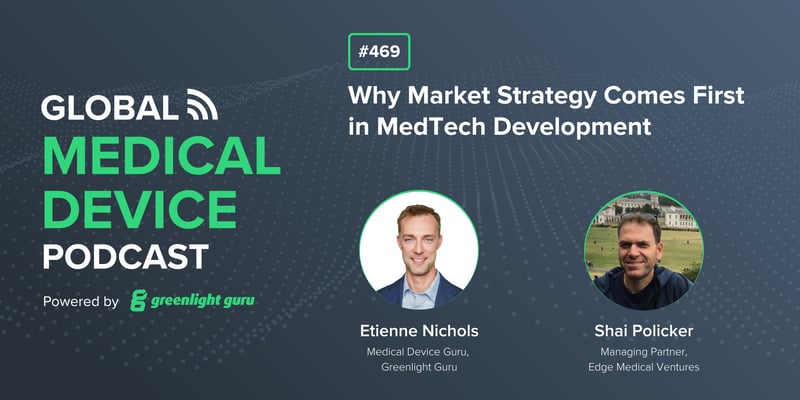
Medical device startups frequently fall into the trap of developing complex technology first, only to struggle downstream with clinical adoption, regulatory hurdles, and reimbursement. In this episode, host Etienne Nichols sits down with Shai Policker, Managing Partner at Edge Medical Ventures, to explore why reversing this traditional paradigm leads to sustainable, category-defining products.
Policker details how working backward from validated clinical needs—identified directly by multinational corporations, physicians, and health systems—allows developers to map out the regulatory and reimbursement landscapes before building the first prototype. By addressing the commercial critical chain early, ventures avoid costly mid-development pivots and align technical innovation with true market demand.
The conversation covers real-world portfolio examples, including non-invasive urodynamics and smart surgical drains, demonstrating how focused differentiation transforms clinical workflows and patient outcomes. Policker also shares key insights into helping international MedTech companies navigate the nuances of the US healthcare system.
Watch the Video:
Listen now:
Love this episode? Leave a review on iTunes!
Have suggestions or topics you’d like to hear about? Email us at podcast@greenlight.guru.
Key Timestamps
- 00:31 – Introduction by Etienne Nichols: The core flaw in traditional medical device development.
- 02:33 – Unmet Needs First: How Edge Medical Ventures sources pipeline needs from multinational strategics.
- 04:12 – Real-World Case Study (Urologic Health): Transitioning from invasive catheter urodynamics to non-invasive diagnostics.
- 06:32 – Ideation & Strategic Filtering: How Edge narrows down dozens of concepts into 1–2 high-value ventures annually.
- 09:37 – "If You Build It, They Will Come" Fallacy: Why technological novelty fails without commercial viability.
- 11:13 – US Market Pitfalls: Common missteps international entrepreneurs make regarding US healthcare economics.
- 13:22 – Category-Defining Devices: Defining what makes a product lead or create an entirely new MedTech category.
- 14:20 – Micro-Timestamp Case Study (Xero Medical): Surgical drain sensors tracking GI tract electromechanical motility and peristalsis to detect post-op complications early.
- 17:46 – Clinical Differentiation vs. Engineering Bias: Requiring dramatic clinical outcome improvements over minor technical tweaks.
- 21:01 – The Critical Chain Principle: Evaluating reimbursement, physician workflow, referral patterns, and regulatory pathways as interdependent links.
- 23:36 – Case Study (Synchrony Medical): Redesigning airway clearance vests to match manual physiotherapist techniques while leveraging predicate 510(k) pathways and existing CPT reimbursement codes.
Top takeaways from this episode
- Validate Reimbursement Before Prototyping: Map existing CPT/HCPCS codes, coverage policies, and economic incentives prior to freezing design specifications.
- Leverage Strategic Partnerships Early: Engage R&D, sales, and clinical leaders at strategic corporations to identify validated gaps in three-to-five-year commercial pipelines.
- Target Dramatic Outcome Improvements: Focus engineering efforts on innovations that yield step-function clinical improvements rather than incremental 5% gains.
- Preserve Familiarity for Pathways: Design physical devices to deliver game-changing outcomes while maintaining predicate-equivalent forms to fit existing 510(k) cleared classes and billing mechanisms.
- Evaluate the Full Critical Chain: Ensure every element—referral patterns, physician time, hospital economics, regulatory constraints, and patient compliance—is fully solved before committing venture capital.
References:
- Edge Medical Ventures: Venture creation firm focused on category-defining medical device companies built around validated strategic needs.
- Etienne Nichols LinkedIn: Connect with podcast host and MedTech community leader Etienne Nichols.
MedTech 101: Understanding Strategic Concepts
Active Implantable Medical Device (AIMD)
A device that relies on a electrical energy or power source (other than directly generated by the human body or gravity) and is intended to be totally or partially introduced into the human body.
Analogous to a cardiac pacemaker, which uses internal battery power to deliver electrical pulses directly inside the body.
Peristalsis & GI Motility
The natural, wave-like muscle contractions that move food and fluids through the digestive tract. During colorectal surgeries, this motion often pauses (ileus).
Imagine squeezing a tube of toothpaste from the bottom to the top; tracking the electrical signals of these squeezes tells physicians if the gut is recovering post-surgery.
510(k) Predicate Device
A legally marketed device used as a benchmark to prove that a new device is "substantially equivalent" in safety and effectiveness.
Think of it like using an existing certified vehicle design as a reference when submitting a new car model for safety approvals, avoiding the need to re-invent safety standards from scratch.
Memorable quotes from this episode
"If you take great technologists and change them from 'if you build it, they will come'—which actually doesn't work that well—to knowing what to build, they will build it." - Shai Policker
"It's a critical chain. Every chain is as strong as its weakest link. All you need is one piece of the chain that doesn't work, and it's dead—not weak, it's dead." - Shai Policker
Feedback Call-to-Action
We want to hear from you! What was your biggest takeaway from Shai Policker's approach to venture creation? Do you have topic suggestions or guests you would like to see on the show?
Send your thoughts, feedback, and questions directly to the team at podcast@greenlight.guru. Every email receives a personalized response from our team!
Sponsors
This episode is brought to you by Greenlight Guru, the only MedTech lifecycle management platform purpose-built for medical device companies.
Whether you are mapping out early-stage regulatory strategies or preparing for commercial distribution, Greenlight Guru combines an industry-specific Quality Management System (QMS) with a modern Electronic Data Capture (EDC) solution. By linking your clinical trial data directly with your quality and design controls, Greenlight Guru helps you manage the full critical chain of medical device development efficiently and compliantly.
Learn how to accelerate your medical device journey at www.greenlight.guru.
Transcript
Etienne Nichols: Hey everyone, welcome back to the Global Medical Device Podcast. My name is Etienne Nichols. I'm the host for today's episode. Today we're going to be talking about one of the biggest mistakes I see in medical device development. And that is where companies build the device first and then figure out the market later.
So, we're going to be talking about what happens if you flip that equation. What if before you even design the clinical trial, before you map the regulatory pathway, before you think about commercialization, you ask the much more difficult question, and that is what makes this product meaningfully better than everyone else in the category?
And not just better in a technical sense, but better in a way a physician will care about, better in a way a patient, or better in a way even that a payer will reimburse. So ultimately better in a way that you can actually prove through your regulatory and clinical strategy. That's the philosophy behind today's conversation with Shai Policker, he's the managing partner at Edge Medical Ventures.
Shai spent decades on both sides of the MedTech equation from research and technology development to operations and commercialization, now investing and sitting on the boards of the portfolio of medical device companies. He was the CEO of EndoStim, which developed and commercialized an active and plantable treatment for severe GERD. And today he works with Edge Medical Ventures to bring mature category defining ventures into the US market. So that category defining part is the important part.
Because Shai and his partners aren't they're not waiting for entrepreneurs to walk in with the next big idea. Oftentimes they're starting with that unmet clinical need identified by a strategic company. And so, they ask the question, how do we turn this unmet need into a company that actually works within the US and wins? So, I don't want to get too far ahead of myself, but Shai, how are you doing today? And what I'm sure there are gaps that you could fill in with your background, but glad you're on the show today.
Shai Policker: Thanks well great to be here. You already said it all, so
Etienne Nichols: No.
I cover the easy part so you could get the no.
Shai Policker: Completely stole my thunder so no that's fine that I wanna very good introduction very good introduction I wanna…
Etienne Nichols: And so, I want to hear how you do this. So, I mean, we could talk about this at a high level and just say this is what we do, but really how does it how do you pull this off? Because I oftentimes companies, I mean regulatory clinical reimbursement, commercial strategy, those are different departments and it's hard to get them to speak the same language, let alone know the goal that we're headed towards. So how do how do you just tell me how you build companies and how you approach this?
Shai Policker: So, as you mentioned in in many cases, this starts with an unmet need coming up in a discussion we have with a multinational corporation that shares with us what they would like to see in their pipeline, let's say three to five years from now, or you know, even sometimes even sooner or even later, if it's a structural hard company, for example, it's never just five years. So, this gives us an opportunity.
To dive into that unmet need and the motivation for why would you need that extra product that it not was not even invented yet? Why is this important? Then this gives us a great opportunity usually to understand, you know, what's the real estate out there that you can still, if you own it from a competitive standpoint, you will be a winner.
So, this could be a market where there are already products out there providing some solutions. They're just not good enough. And there is an important let's say, parameter, one or more parameters that if you are able to really excel on those, you can win the market. This is where it could give you. well, one example again, I can use our portfolio. We have a recent device company doing non-invasive euro dynamics.
Checking the health of the bladder of people. the big challenge there is usability. You need to really insert two invasive catheters to the rectum and the urethra of patients in order to get accurate results on the pressure, on the behavior, the dynamics, and all that. That's a huge limitation on usability. Patients do not want to use it.
When you have a patient, let's say with DPH with the you know benign enlargement of the prostate, you would want to check them every three months or every six months. Nobody would ever agree to do that. So, imagine if you can bring to the market a non-invasive urodynamic system, that would change the world completely because then, yeah, if this is so our company, Urologic Health, has done is exactly that.
Based on an admit need we got from a strategic partner, actually talking to several strategics. And we understand that this invasiveness, if you bring into the market a system that that do use catheters and can be used at home or you know, have all kinds of usability advantages, this can first multiply the market that you have today for diagnostics.
And also help drives therapies. So, there is like here is our incentive. Yeah, we can sell more neurostimulators for overactive bladder, we can sell more treatments for before and give them to patients really on time when they are just before the risk of getting irreversible bladder damage.
So that that's kind of a one example of how those things are happening now. Before the first resistor or measurement or anything was done on the design, we knew what the reimbursement landscape looks like. What are the codes? What are they what is the competition? What is coming up? And when you are talking to strategics that are competing in this market, you can learn a lot about you know what's going on. something that even a fund that is interested in urology wouldn't maybe not be aware of.
So that that’s really what giving us the information, and then when you find, you know, great entrepreneurs like the ones that we are working with that can invent, they see the goalpost as something that will be successful in the market, not just, okay, let's just create a new tech great technology and hopefully somebody will buy it someday, you know?
Etienne Nichols: Yeah. So, I want to start at that conversation. So that conversation with the strategics, there's two things that happen, it sounds like. Obviously, they have the things they're focused on, and they communicate that with you. That's when the connection happens. And then you go downstream and you make it happen. So that conversation, how do you so you've built relationships, I assume, with multiple strategics. How do they convey that information to you? Is it we have a problem in our pipeline?
Meaning we have we treat this, we treat this, we treat this, but we have this noncompliant issue that people don't tend to take it, or they don't it's just not working very well. So, can you solve this? Or do they say, we need a non-invasive BPH monitoring device? Or you know, they're telling you the solution or they're telling you the problem. I'm curious how that conversation even goes.
Shai Policker: It's usually it's almost never like here is what you we would want you to invent. It's a more broad interest in like an area. and usually this is like you know, we find they describe an area of interest, and they tell us a little bit about what they are doing there, what competition is doing there, and they let us figure out, you know, some ideas.
And then we then we go home, we do some thinking and we come back. Okay, what if we do this? What if we do that? What if we do that? Will this help? And in many cases, they would kill those ideas very easily. And the nice thing is that the discussion is not necessarily at this point with any business development or venture people.
These are discussions with the VPRDs, directors of RD, sometimes upstream marketing, sometimes, you know, even sales teams that are selling some something similar and we learn more and more and then eventually you know from a pretty large list in the beginning we narrow it down sometimes it is our own understanding you know we understand better some areas and we you know so we can choose the things that seems to be interesting and things that we think well maybe we can solve this and come back to them with solutions or potential kind of very broad solution and they will kill some of those and eventually we'll end up with just one or two a year.
That's it. But on those two, we'll put in like the best entrepreneurs we can find and innovate together with them. So, it's a process. Sometimes it can take six months from the first discussion on a on a topic until we really say, okay, now we understand what we need to do. Let's go figure it out how the technology, how technology can fix that problem.
Etienne Nichols: So, I can see the versatility being really important because I a lot of times, I mean, if I just look at the way a lot of companies are built right now, you might have someone who's good at one thing and they start working on that, they're designing it, they get a few other people who are good at that one thing.
But it sounds like what you have is it's this you're almost looking for that Venn diagram. This company has multiple things that they need. You have multiple things you can do; you find the overlap and then you really pinpoint into that one thing. how do you that that seems like you'd move a lot faster than most companies doing it that way too.
Shai Policker: I think that the magic here is because we know what to build, what is needed.
Etienne Nichols: Yeah.
Shai Policker: We see so many. I mean, our door is open to entrepreneurs coming to us with their ideas, solutions, you know, prototypes. We talk to a lot of them, and the vast majority of them we will say no to not because we don't like the technology or we don't like the people. Sometimes these are great people.
And unbelievable technologies. Yeah. They're just solving an uninteresting problem. That's the biggest issue. Or…
Etienne Nichols: Yeah.
Shai Policker: A problem that you know, yeah, you it's interesting maybe clinically, but there is no way anyone will pay for that, or something of that sort. When we come back from the unmet need, we've already answered all of those you know issues. and sometimes we the strategic will tell us about ch change in l the landscape of reimbursement in a certain field.
That opens up a range of opportune of new opportunities. This is something that maybe we can take advantage of if we innovate here. And that's something that we can come back and so I think that helps a lot. if you take great technologists and you so you change them from you know, if you build it, they will come. That actually doesn't work that well. No. you know, if you know what to build, they will build it. Or something that like that.
Etienne Nichols: Now, so it sounds like you've got a lot figured out in your supply chain of ideas and then developing those ideas. And I know a lot of that development happens in Israel. You work with companies coming from Israel and other markets into the US. What do those companies what would you say they misunderstand about the US market? Is there any common misunderstanding that I think would be helpful to just kinda highlight or I I'm sure everything's not perfected completely, but yeah.
Shai Policker: Yeah. No, unfortunately, I would say the typical Israeli entrepreneur, not all of them, but because there are some like repeat CEOs and repeat founders that have been successful, but many, many of them they just have no clue about how to you know go through some of those really un-logical sometimes and crazy obstacles in the US healthcare system.
These are really genuinely hard things. And especially if you're coming from technology or coming from engineering, you don't expect to find those major obstacles on the economics and on the clinical workflow and things that you just you know, if you're not a physician working in a US hospital or somebody or in a or healthcare administrator, you there is no way that you would know. you know, somebody needs to tell you, remember.
Look, there is a there is a there is a problem there. You have to the figure out how to you know how to fit into that reimbursement code. Otherwise, nobody can afford it. Nobody can build it.
Etienne Nichols: Yeah. Man, I love starting with the reimbursement code too. That's just that's one of the biggest hurdles. And when I go to shows and people, I'm talking to entrepreneurs who are on the cusp of maybe they're getting their submission done, they're really wrapping that up and they say now we're looking for a reimbursement first.
I'm like, now so and that but that's very common that they're looking for and reimbursement is very in demand. If you're an expert in reimbursement, and I know a few people who I recommend, but it's just they are swamped because the people are just coming to them a little bit late in the game, so they have so much work to do and…
Shai Policker: Yeah. No, we would be talking to the reimbursement people bef again, before we start building the product.
Etienne Nichols: Even before the prototype. Yeah. Yeah.
Shai Policker: Absolutely. Absolutely.
No, no question. Now I will mention that there are kind of other channels that we are using. Sometimes the unbed need would come from a hospital or a physician. But then we would always go and validate it with our partner, you know, strategic partners.
Etienne Nichols: Yeah. Okay. So, there was another thing that we talked about a little bit in the in our conversation before we hit record, but that was the category defining section. So, what does that mean? What makes a medical device category defining? How do you determine that?
Shai Policker: So, this is really that it all comes back again to this unmet need. When you look at a category, you know, we can again talk maybe talk about the urology product. When you have a like you know a group of products with some and all of them share a certain limitation that is major, that is important, and you can overcome that, you would become a category leader.
If you don't, of course, if you can still fit with the same reimbursement code, or you can find some way to get paid and your costs are not high, you know, and you still keep physician, you don't take too much time or effort or cost from physicians, you know, all of the things keeping the same, such a product, your logic health will almost definitely become, we believe, a category, a category leader. Another thing is that when you're just first.
When there is nothing like that in the market. Another com company I can I can show you an example, talk about an example is a one of our first companies, Xero Medical. That's a company that is just finished their pivotal trial and they're you know waiting for FDA clearance. This is a surgical sensor; it's a drain that you drain with a sensor that you place at the end of colorectal surgery.
With the goal of tracking the recovery of the GI tract after the procedure. So, you put the electrodes, it's a bunch of electrodes on a standard surgical drain, doesn't change the surgical procedure at all. And it basically does like an ECG of the GI tract, measures the impedance and the motility so, the GI tract works very much like the heart in terms of propagation of electromechanical motility.
And after any kind of surgery, definitely when you do a colorectal resection, when you cut a part of the GI tract because of cancer, for example, or something like that, and you reconnect, you will get a disruption of motility. So, there will be like some kind of a paralysis in the GI tract for a while for 24 hours or 48 hours. And then slowly when it when recovery is normal, slowly it will come back. You will see inflammation subsiding slowly. In the beginning, you have a lot of inflammation, and it goes down.
And then motility will come back. If you put electrodes along the GI tract near where the anastomosis was, you can really track that. Nobody has ever done this. The theory was there; it was all in the in the medical books. Nobody was ever figuring out how I can really exploit that you know physiological characteristics of the…
Etienne Nichols: Peristalsis isn't that isn't that what I I'm trying to remember from biology.
Shai Policker: Exactly, it's exactly the peristalsis, it's the electrical and mechanical elements of the peristalsis. It also the mech the electrical elements that tells you if there is local inflammation. You know, impedance tends to go down when you have more fluids in the tissue and things like that. So, we just placed and as it turns out, you can find a form factor that will allow you to place the electrodes there.
In multiple places very easily without changing anything in the way they do it. You just take you know, whatever, ten cents drain and you just add electrodes…
Etienne Nichols: Hm. Amazing. Yeah.
Shai Policker: Find complications way in advance that's what our clinical data what the clinical data shows we the company got a breakthrough designation from FDA they've done almost 300 patients in in clinical trials and there is nothing like that so the comparator is a CT scan that will give you know not so such great results you know way later so that's something that so this is published data.
This is something that was discussed on you know on podium of this of surgical society and this will become a category leader. It actually creates a new category of the tracking recovery, post op recovery of patients. So that's another example. So, you don't have to come into an existing category, you can create your own. That's sometimes even better and easier.
Etienne Nichols: Well, okay. So, if we talk about so moving away, because that makes sense. creating a category makes total sense. That's probably the ideal way to do so bringing something new instead of just following other people into the market, making it slightly better. But you talk about starting with what is special about our product. And that category defining thing makes sense. But if we go back to maybe you, have it a product that's going to be something similar to something else, or how do you separate
Something that's genuinely differentiated from something that your engineering team just believes, we're better because we designed it. You know, how do you actually make that the termination?
Shai Policker: Because we don't the technology, I mean, of course I like technology. I'm an engineer myself, you know, a recovered engineer, as they say.
Etienne Nichols: Yeah, that's me.
Shai Policker: But we go to the clinical data. What would make the technology differentiated is that you get better clinical outcomes.
Etienne Nichols: How much better matters?
Shai Policker: Dramatically, it needs to be dramatically better. That's if it's slightly better.
There could be some situation where even like five percent with you know a small advantage will give you in a huge market can give you an advantage. This is not typically something that we like, we like to do. We're looking for things that will be unquestionably, you know, something new different. It's like the you know, digital cameras versus Polaroid.
Like a like a game changer in the in the market. That's this is what we like. And in that case, we don't even care so much if this is like you know usually venture capitalist wants to see like a multi-billion-dollar market. We don't really require that. If I see a $500 million dollar market and I'm going to be the only one that everybody will buy, I'm happy with that. Especially if I'm getting it's a med company that you know these days valuations are not great on those early-stage products this gonna make a very nice multiple and return at the end of the day.
Etienne Nichols: How do you how do you move so fast? You said one to two a year. That seems like you're really cranking through a lot of products. Or is each one of those have a long lead time? How d how does that work, your timeline?
Shai Policker: So yeah, it takes us a long time until we actually make a decision about a project. So, I you know, starting with a discussion with a strategic, and then we would go to multiple physicians, and we'll talk to those reimbursement experts and regulatory people. And we wanna understand that we have the full picture before we even start. And then we need to pick and choose from our big networks or network of entrepreneurs who is the who is which is the right fit, which is the team that can actually crack that, and you know.
They're not always available, or you know, so until all of those elements are perfect in place, we would not start. So, we could have things that are on in the you know, like in the oven or in the freezer, maybe for a while until the missing part comes, and this this is the guy that can make this happen, or yeah, we got now, we got the answer, or we have to wait until that reimbursement regulation comes into play or something like that.
And then we push we pull the CR we pull the trigger. So that that's something that could that this could take you know, sometimes it could take two years for something that from the first time we heard about that, or we thought about it until it becomes it sees the first patient. It couldn't be a very long time, but we would not invest really until then. We'll invest our time and our effort and we learn a lot, and this is a lot of fun for us.
But we will not be using investor money yet. we are still a small fund. We are still a small fund. So, when to be ready to make that kind of investment decision, it's a big deal for us. We've only done six investments so far in the in the new fund, and that one is already for companies that already have done the clinical work, so they're already past that kind of venture creation stage.
And then we help them get to the US, land safely and you know, execute on all of the all of the things that they need to do in the US.
Etienne Nichols: Just completely aside, but nice work modifying that analogy, saying instead of well, let's we've got several in the oven, well, it'd be the freezer. Like not a lot of people think that quick in the moment, so that was pretty good. so okay. The thing that you're you said patient outcomes.
That was the biggest thing. What about how much do the other elements weigh into the determination of this, such as so we have patient outcomes, but what about physician workflow or economics from the payer side. d is it is it primarily like an eighty twenty rule where okay, we mostly care about the dramatic change to the patient outcomes. These other things are, you know, bonus or cherry on top, or how do how do you weight those different elements of determining what you're gonna work on?
Shai Policker: It it's a critical chain. It's ever you know, every chain is as strong as its weakest slink. So, all you need is one piece of the chain that doesn't work, and it and it's dead. It's not weak, it's dead. That's it. If there is if your imbursement doesn't work, if something in the referral pattern doesn't will not be appealing to physician and they will not they will you will just not see the patient.
And I've and I've been there. I mean, I've seen how amazing how amazing product can you know, sunk into the mud and be very slow to come up if you have some problem of communicating between two types of physicians, something like that can really so you have to figure out, you know, as much as you can from the chain. There will be surprises along the way, even if you think you understand everything, there will still be surprising surprises along the way. So, you have to you owe it to yourself and your investor to do the homework completely before you get started.
Etienne Nichols: Yeah. Yeah. Well, the another question is can you have too many differentiators? is there actually a danger in being, you know, make a device that's better at five different things versus being like is a little bit better at five different things or consolidating into one device versus being dramatically better at one thing? I mean, how does that?
Shai Policker: Yeah, if there are too many novelties, then I think some of the other investors we would want to work with or strategic partners will be okay, this is maybe too innovative for us. Let's wait and see how this progresses first. that's that that can happen. The really the best thing is that everything looks very familiar, looks great, but there is one thing that is a game changer. And you explain that thing, and it affects a clinical outcome, for example, but it doesn't affect reimbursement, it doesn't affect regulatory.
Again, another, I'll give you one more example. Is a company that we already have in the market, is a company called Synchrony Medical. It's a wearable device for airway clearance. It helps patients with bronchiectasis CCF clear out their mucus. They have to cough out mucus every day.
Basically, they need to in an ideal world, they would need to see a physiotherapist, a chest physiotherapist every day for half an hour and help them kind of clear their mucus. It's just impossible to do. it's there is no capacity for that. So, you have in the market quite a few wearable devices like that that that you wear as vests, and they are percussive. They are it's like tapping on your back and it helps you clear your mucus a little bit. Yeah.
So, we met with a physiotherapist in the in the Sheba Medical Center. It's the largest hospital in Israel that we work with. And he says, well, why don't you take what I do with my hands, which works so much better than those vests, and just implement it in a in another vest. And we try that. So instead of having something that is kind of oscillating, it's multiple pockets that inflate and deflate and mimics the hands of the physiotherapist.
He uses this physiotherapist uses a known method for manual physiotherapy that is very hard for the patient to do on the on their own or the partner to do on them. But you can do it if you have a vest with those pockets…
Etienne Nichols: Yeah.
Shai Policker: That is synchronized to like a virtual physiotherapist in the in a in a tablet that tells you now take a deep breath, now do that, now cough out the mucus.
And in the meantime, in exactly synchronized to your natural breathing cycle, those pockets inflate and deflate. And we did a head-to-head trial against you know the leading other product. And we saw that patients cough out double the mucus, even more than that.
Etienne Nichols: Really? Wow.
Shai Policker: Strong, a very strong competitive edge on the on the clinical outcome side.
Etienne Nichols: Yeah.
You talk about double. Yeah.
Shai Policker: Yeah. And also, you saw patients say telling us, listen, this is actually nicer on the body because this percussion, you know, it's it gives me a dizziness. It gives it, you know, I really like your product. So, we had, this is on the clinical side. That's nice. However, this is a wearable vest. And the inflation of the pockets are kind of doing in a in a cyclic way. So, it qualified for 510(k).
For the regulatory, so we the other vests are predicates. We're perfect predicates for our vest. The reimbursement code that we are using, exactly right for our vest as well. We built it in a way that you couldn't argue otherwise. It's really is the so we got the FDA clearance, we got the Medicare approving us to use the existing code, which is you know, there's like fifteen, sixteen thousand dollars coverage for home use for, you know.
Etienne Nichols: Yeah.
Shai Policker: And this is in the market now. So, everything is the same for the patient. It's sold through the same channels. It's a durable medical equipment. So, we have distributors selling this. patients are using it at home for a short amount of time. It's really something very similar to a pulmonologist in the clinic or physiotherapist in the clinic to understand what we do. It's very, very similar in many, many ways to what you have, but it's better.
So, you that that's your differentiator and you have you only have like a w a couple of those and everything else looks the same and they code it the same and you know they know everything is medically is written the in the same way. So very easy.
Etienne Nichols: So do you so as it feels like to try to remember our conversation, when you talk about that thing, it's so much better and it has better patient outcomes, but you're able to use this predicate, you're able to use a very similar claim. Do you think that the thing that makes this product special should that ultimately show up in the regulatory claim itself? And it can walk me through that connection.
Shai Policker: I we could make made it look completely different, work very differently, you know, put on the body in a very different day. We chose intentionally to make it to go through the familiarity, not to move you know the cheese too much, because exactly what you know how we…
Etienne Nichols: I love the reference.
Shai Policker: And you know everything is the same, but slightly better. Well, so you should use this one.
It's even the same price, you know? So, you should use this one.
Etienne Nichols: Yeah, that's good. I don't know if you're referencing the book, “Who Moved My Cheese?” I used to read that every year. I need to go back and read it again. So good. okay. So, what do you think is the earliest point? And I I think I already know the answer to this, but that you should be talking to regulatory. If you're a product development, it sounds like I mean, you said before you even have the prototype, but does that then dictate how you do the product development? Yeah.
Shai Policker: Absolutely. We first we saw how the predicate is written. We looked at how the reimbursement code is written. And this guided our product development process to make sure we are we will fit that box. And still we'll have our technology embedded there, you know, because we are there are some differences, but it should not be too different, so it will not fit the code or the regulatory you know pathway.
Etienne Nichols: Yeah. If you could force every early-stage company to put like something on the wall for their like a sentence on the wall before starting any trials, any prototyping, what do you think that sentence would be? Can you think of something?
Shai Policker: They need to think about the plan first and act later, but this is you know…
Etienne Nichols: Actually, I wanna ask you about that and I'm gonna buy you some time. I'm sorry, I don't mean to cut you off, but you said something about that planning phase and it takes forever. You know, you got all the things in the freezer before you finally decide, all right, we finally got the missing ingredient, let's make the cake or whatever it is you're making. Do you think it's a cultural thing? Now I recently read the culture map, and it talks about how German Germany, for example, they really, they deliberate and they argue and they clash and then they finally come up with a plan and that plan does not change.
And it's like a cultural thing. Whereas in the United States, we make a decision and then two weeks later we're like, you know what, actually let's do this. And so, it's like always, you know, changing. And I what you're describing almost seems a little bit somewhere in the middle. I don't know.
Shai Policker: A hybrid. Yeah. Because we would we would argue a lot and talk a lot and plan a lot before we do the first step, and then we will continue and we will keep our mind open. And sometimes we hit you know a roadblock that we didn't think about, and we would pivot even in those you know that that's one of the most important things I learned through my you know long life is never be married to your ideas, you know. If you if you see that your original thinking was wrong, just change your mind. Yeah.
Etienne Nichols: Yeah. I recently read a line that I really liked. If there's any doubt, there's no doubt. That means, you know there's so and the other thing I was thinking about is it's just it's yeah, it's hard.
Shai Policker: It's extremely hard. First of all, as an as an engineer, as something that likes to build things, you know, I can tell you as a young person, the first drive I have, let's build it first and see how it goes, and then we can figure out to change it. That's that doesn't work usually.
Etienne Nichols: Yeah. Yeah. Having all of that beginning with the end in mind, I think is Stephen Covey's. And then, you know, there's an Eisenhower quote too that I like. Planning is everything. Plans are nothing. And you know, so all the different things. It's interesting. What about okay. So, reimbursement strategy should influence the product itself. I think that's something we've kind of pretty much nailed down. what do you think the clinical strategy looks like when the reimbursement is already kind of looked at. I mean, I would assume d are there any differences between a reimbursement driven clinical study or strategy versus a traditional regulatory clinical strategies that…
Shai Policker: No, it's a very it's a very good point because when we are planning, this is this is not necessarily something that you have to do on day one, but very early you when you know when you have your regulatory pathway, you kind of have your clinical trial requirements, more or less, you know, what's the statistics, how many patients FDA would want to see, and things like that. So, one of the things to make sure is that when you write your protocol, which is first will be very focused on FDA requirements.
Let your reimbursement person review that because they and they always would make small but very important changes that will make sure that you still you also prove you know the economic point or something like that. And I I will say also, and that's something that you know this is in our recent month. I've been talking a lot with our CEOs. clinical strategy doesn't end when you get FDA approval.
Yeah, you your post marketing trials are in many cases the ones that will differentiate your product. Not everybody, it's not always that easy for everyone to understand why you are better. You need to demonstrate it in in post market clinical trials. It lets the KOL gives the KOL something to talk about on the podium and explain that. There is it becomes a discussion point and it's a marketing tool.
That is super, super important. And you have to plan for it. This is also something, again, not necessarily in day one, but when you see FDA clearance kind of on the horizon, you should start thinking about post market clinical strategy.
Etienne Nichols: So even if you're a 510(k), even if you're Class II, there's no requirement, you're saying we're gonna we're working on our clinical strategy effort.
Shai Policker: In all of our companies, we are doing what do you say? Regulatory unrequired, if you call it the clinical product, yeah. We do yeah, synchrony is the one with the vest. That's what they're doing now. They are already in sales, they've sold. I mean, they're in the market for a few months, they've sold you know quite a lot of products already. They many of their patients are part of clinical trial to look at long-term impact, you know, on the on their lung function. And we think that this is gonna give us more advantages, more, you know, more differentiators, things that our competitors have never done, and we will have the data to show for it.
Etienne Nichols: Yeah. What about breakthrough device? I f I feel like a lot of founders, they'll say, we're a breakthrough device and they think it's basically an exhibited FDA pathway or we're really impressive. What i is that synonymous? What how do you see that?
Shai Policker: Yeah, we have I think two of our companies are breakthrough. we are using it. First of all, the process with FDA is a little bit different and help and it's helpful. The second thing, and it also, you know, the process is also helpful. When you are submitting a breakthrough designation, you are saying there you are suggesting some kind of regulatory pathway.
And sometimes you don't you're not sure what FDA will say if it's 510(k) or the novel or PMA. It's a way to get some kind of it's almost like a Q-Sub. It's a kind of a Q-Sub. I don't know if FDA would like what I'm just saying now.
Etienne Nichols: Yeah. That's it. Another key shop. Yeah.
Shai Policker: It's kind of asking them a question without like formally asking them. You will get some feedback about it, some informal feedback about so that that's helpful. And then if you get a breakthrough, you get a I think there are some advantages on the regulatory pathway.
And also, you can use a re there is a reimbursement advantage. in Xero, we have a breakthrough designation, and we applied for an NTAP with the new technology at additional payment, something like that. It's like extra reimbursement for Medicare patients. and we have also another product in in the field of dialysis, diagnostic device and dialysis in a company called Patency.
Also, breakthrough designation, and there is a like a separate pathway there for some special reimbursement that you can do, or specifically in dialysis. So yeah, that's definitely something to use. I think that's kind of I know there was a lot of changes there, and not everybody is very happy with you know the way this pathway, but you know, you just have to use what you get. There used to be pathways like that in Europe, which are practically gone now in Germany. and what we have in in the US, I think is better than nothing. Then I think you know you should look at it and try to use it. yeah, I would like very much for something like that to happen in Israel, for example.
Etienne Nichols: Sure. Yeah, it's interesting because we all look at things through a different lens. You know, if you're the user of the product, you want very safe. If you're trying to get something in the market, come on, we wanna help people. So, let's get on the market. So, we always look at things through a different lens. And so let me I want to ask you a different question though. kind of you know, I mean, we could talk about regulatory strategy and that's interesting, but I'm also interested as an investor, when you're evaluating a med tech company.
You've looked at you mentioned sixteen different products, sixteen different companies now, which may not sound like a lot, but compared to a founder who's this is his first time or maybe only second or third, what would you say? Not to be boastful or anything, but having evaluated so many of these, what do you think you could figure out in probably thirty minutes that it's gonna take some of these founders three years to figure out? Is there anything that come to mind?
Shai Policker: Yeah, it's a this is a hard question because usually even in less than 30 minutes we figure out quite a lot.
Etienne Nichols: Yeah.
Shai Policker: And this is just experience, and you don't always know how to explain it's just so many things that we have seen. I mean, we've seen thousands.
Etienne Nichols: Yeah, well we're up in the fire tower looking at the entire forest. I mean, you know, versus the guy down there in the trees. So yeah, it's different.
Shai Policker: So, it's hard to answer, but we would be we would be able to see a lot in the first 10-15 minutes of the discussion. Sure. and yeah, we would and we would try to come to a meeting with the founders when we already have done our homework and we, you know, we looked it into something now, you know, to these days with AI, you can learn a lot very quickly.
So, one of the goals that we have on our objective is that, you know, the ninety-nine point whatever percent of the entrepreneurs that we say no to is that they don't live with nothing. They don't get money, they don't they don't get an investment, but they may get some kind of helpful advice or some kind of you know, a new idea or something. Yeah, you really should look into that. And sometimes they will come back.
Yeah. And with a little bit with more things figured out and maybe a bit of a pivotal and our door will still be open.
Etienne Nichols: Yeah, that's cool. That's really good. Okay, I know we're kind of cl coming close to time. Is there any last piece of advice that you give to anyone working on medical device, whatever department they're in, just anything that you would recommend or calls to action. Go look at this, go do that. Just any requests or advice that you give the audience.
Shai Policker: So first of all, of course, if you have a clinical stage product and you are looking to sell in the US, you're looking for an investment, yeah, we're happy to talk to you. Cool. And any of those medical device corporation that we still don't work with, our door is also open to them. if we see ourselves as an innovation powerhouse and we can help them kind of become more competitive in the markets. So yeah, we are happy to work with both of those entities and hope to do more of those in the next few years.
Etienne Nichols: Awesome. Well, I appreciate what you're doing to innovate within the medical device innovation industry. it's an exciting way to develop medical devices and I think it's one that I think a lot of people could stand to mimic. So really appreciate it. We'll appreciate the conversation.
Those of you who are interested in learning more about what Shy is doing at Ed Edge Ventures, we'll put the link in the show notes so people can go check it out. And until next time, thank you so much for listening. We'll let you all get back to the rest of your day but take care.
Shai Policker: Thank you very much.
About the Global Medical Device Podcast:
.png)
The Global Medical Device Podcast powered by Greenlight Guru is where today's brightest minds in the medical device industry go to get their most useful and actionable insider knowledge, direct from some of the world's leading medical device experts and companies.