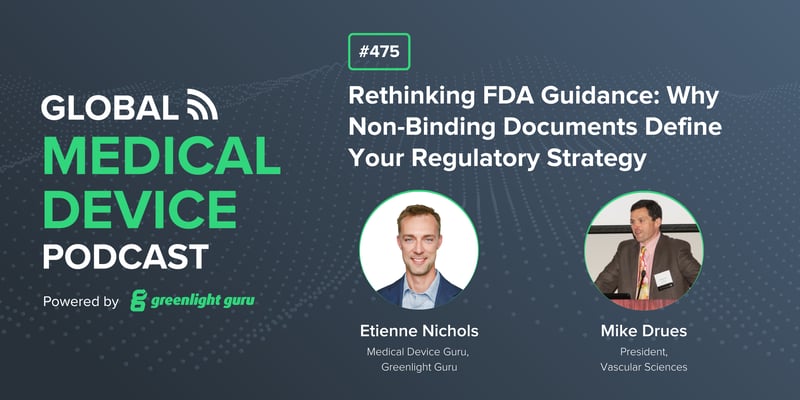
In this episode of the Global Medical Device Podcast, host Etienne Nichols and regulatory consultant Mike Drues dive deep into the world of FDA guidance documents. They unpack what these documents truly represent—the agency's current thinking rather than binding law—and explore how manufacturers can navigate them effectively. The discussion covers the distinction between regulations in the Code of Federal Regulations and agency guidance, highlighting why a rigid, literal interpretation can be dangerous for product development.
The conversation examines the practical realities of using guidance documents as tactical tools and highlights the importance of proactive engagement with the agency. Mike shares valuable insights on challenging assumptions, understanding the shades of gray in regulatory compliance, and the strategic advantages of addressing deviations early through the pre-submission process. They also touch upon the limitations of the FDA guidance database and why revision history matters.
As part one of a two-part series, this episode lays the critical foundation for understanding how guidance shapes medical device development. Listeners will gain a fresh perspective on interacting with the FDA, moving beyond compliance checkboxes to build robust, defensible regulatory strategies. Stay tuned for part two, where the discussion shifts specifically to the fiscal year 2027 guidance list.
Watch the Video:
Listen now:
Love this episode? Leave a review on iTunes!
Have suggestions or topics you’d like to hear about? Email us at podcast@greenlight.guru.
Key Timestamps
- 00:31 - Introduction to FDA guidance documents and the upcoming FY 2027 list
- 02:34 - Defining guidance documents: What they are, what they represent, and current thinking
- 05:07 - Guidance versus regulation: Code of Federal Regulations (CFR) vs. agency guidance
- 10:50 - Who has to follow guidance? Understanding non-binding rights and responsibilities
- 17:30 - Navigating shades of gray and interpretation in regulatory strategy
- 21:41 - Draft versus final guidance: Why terminology can be misleading
- 25:38 - Where to find and how to search for guidance documents effectively
Top takeaways from this episode
- Understand the distinction: Recognize that regulations in the CFR carry legal weight originating from Congress, whereas guidance documents represent FDA's current administrative or technical thinking and are technically non-binding.
- Avoid absolutism: Do not treat guidance documents as immutable laws; manufacturers can propose alternative approaches if they satisfy statutory and regulatory requirements.
- Leverage the pre-sub process: If your device strategy diverges from a published guidance document, address the deviation proactively during a pre-submission meeting rather than waiting for a rejection on your final submission.
- Look beyond the database: Use multiple search avenues—including broader web searches and direct inquiries through OICE/Dice—to track updates, historical revisions, and guidance documents currently in development.
References:
- 21 CFR Part 10.115 - FDA’s Good Guidance Practices regulation outlining how guidance documents are developed and utilized.
- CDRH Guidance Document Database - The primary repository for current FDA medical device guidance documents.
- Etienne Nichols' LinkedIn - Connect with Etienne Nichols
MedTech 101 Section
In the medical device industry, understanding the hierarchy of regulatory documents is essential for getting a product to market efficiently. Think of the Code of Federal Regulations (CFR) as the traffic laws established by a governing body—they are formal rules of the road, and breaking them carries a clear penalty.
In contrast, FDA Guidance Documents function more like advisory speed recommendations or warning signs before a sharp curve. You are technically permitted to take that curve at a different speed or use an alternative engineering route, but the burden of proof rests entirely on you. You must provide robust data and scientific justification to prove that your alternative approach keeps the vehicle safely on the road.
Memorable quotes from this episode
"The surgery went perfectly, but the patient died anyway. The we followed the regulation perfectly, but the patient died anyway. This is exactly what gives regulatory a bad name." - Mike Drues
"Every single flowchart that FDA has published, every single one of them is wrong... The better way to say it is, every single one is incomplete. Flowcharts are a starting point. They are not an ending point. Guidance documents are a starting point." - Mike Drues
Feedback Call-to-Action
We want to hear from you! What topics would you like us to cover in future episodes, or how are you navigating FDA guidance updates in your current projects? Send your thoughts, feedback, and topic suggestions directly to podcast@greenlight.guru, and our team will provide a personalized response. Don't forget to leave us a review!
Sponsors
Managing compliance and digital workflows doesn't have to slow down innovation. Greenlight Guru provides an industry-leading MedTech quality management solution that integrates both powerful QMS and EDC software onto a single platform. Built specifically for medical device professionals, Greenlight Guru helps you streamline traceability, manage risk, and keep your documentation audit-ready so you can focus on bringing safe, life-changing devices to patients.
Transcript
Etienne Nichols: Hey everyone, welcome back to the Global Medical Device Podcast. My name is Etienne Nichols. I'm the host for today's episode. And today we want to talk a little bit about FDA guidance documents. Every October, FDA's device center does something most of the industry probably kind of ignores. it publishes a list, a list of the guidance documents it plans to write over the next 12 months. And that list tells you where the edge agency's head's at, what it's worried about, what it's stuck on, what it's kind of thinking of about getting away from, getting closer to.
So, the most recent fiscal year 2027 list dropped on October first, and there's a lot in there. AI, surgical robots, etc. so today we've got Mike Dreus back with us to talk about this. Mike is the president of Vascular Sciences. He's never met a regulatory assumption that he didn't want to poke at. And so, we'll cover what a guidance document really is, what it isn't, who actually has to follow on, what's coming in 2027, and we'll get to the most interesting question. Should FDA be writing these at all? But before I get too far.
I will say there's so much here that we're planning to break this into two episodes. So, stick with us if the we're the first one we're gonna talk a lot about what guidance documents are. The second one we're gonna talk a lot about 2027 documents specifically. But Mike, before I get too far, how you doing today? Good to see.
Mike Drues: Very well, Etienne and thank you for asking and great to see you as well. And by the way, I think it's wonderful that you're coming out right out of the box and being a little cheeky, a little pokey. So good for you. And so anyway, so yeah, I'm looking forward to having this important discussion about guidance documents on the surface. One can probably not imagine a more boring topic to talk about than guidance documents. But to be honest with you, Etienne and the classic Mike Drues approach.
We're going to try to make this topic not boring at all, possibly even exciting or maybe even fun. And so, I'm looking forward to getting into that.
Etienne Nichols: Yeah. I'd venture to say that those of those in the audience who are listening to the Global Medical Device Podcast are probably not going to be bored by guidance documents, but hopefully we can make them even better than they might ordinarily be too. So maybe we'll just start with what even talk what even a guidance document is. Can you tell us what that is?
Mike Drues: Yeah, absolutely. So, the simple answer to that question, Etienne and is a guidance doc document represents FDA's current thinking. And I use that phrase current thinking in air quotes, as opposed to what, but current thinking on some sort of a topic. It could be a technical or engineering kind of a topic. It could be a more general topic about clinical trial design. It could be a topic about FDA policy or procedure, like for example, the pre-submission process. So, they're basically documents that contain, you know, information that's either technical or administrative, that kind of thing. Some guidances apply to most, if not all, medical devices across the board. So, for example, one guidance that you're very familiar with and we've talked about many times is the design control guidance. That one applies to devices across the board.
Other guidance documents are much more device or technology specific. So, for example, if you're developing a peripheral angioplasty catheter, there is a guidance, just as an example, titled Peripheral Percutaneous Transluminal Angioplasty (PTA) and specialty catheters. If you're doing a 510(k) on a PTA catheter, that would be you know a good place to start.
That particular device or sorry, that particular guidance would only apply to one type of device or one type of technology. If you have a device that emits some form of energy like radio frequency or RF energy, there's guidance on that. But as I said, other guidances like for example the design control guidance, that applies to devices across the board. Yeah.
Etienne Nichols: Okay. and just kind of in preparing for this episode, I did not realize that there was a 2021 CFR part ten dot one fifteen, FDA's good guidance practices where you can actually read the rules around building guidance documents just explains how the FDA reads the requirements that already exist. So…
Mike Drues: And if I could be just a tiny bit cheeky to my FDA friends, sometimes I wish that they would read that. Because some of the guidance, including the current guidance is, and I can give you some examples through our discussion, don't follow all of the details of the guidance regulation that you just cited.
Etienne Nichols: Yeah. Yeah. Interesting. Interesting. Yeah. Okay. Okay. Well let's talk about that then. guidance versus regulation and how you would look at these two, what through what lenses do you look at guidance versus regulation?
Mike Drues: So again, excellent question. Let's dig into this a little bit further. So, first of all, when we talk about regulation in this context, we're talking about the Code of Federal Regulations (CFR). And technically, that comes from Congress. That does not come from the FDA. It's not written by the FDA. It technically comes from Congress. But in reality, Etienne and I would point out that that's the theory. That's not the reality. Because to be honest, I would be very surprised if most of our elective representatives and senators even know what's in the Court of Federations. What it technically comes from is the staffers as well as the lobbyists in Washington, D.C. And the representatives and the senators obviously, you know, sign off on it by voting it or adopting it. So technically it comes from Congress, whereas guidance technically comes from the FDA.
And again, we've got to parse that onion a little bit further because some guidance is remember as I said at the beginning, Audie and when we talk about guidance, it's a very, very broad topic. So, some guidance is like a policy guidance. For example, talking about the pre-submission process, that clearly comes from FDA. But on the technical, the engineering side, when it comes to the testing requirements for an angioplasty either or something like that, that typically directly comes from the FDA, but indirectly it comes from us, meaning industry.
And this is an example of what I call competitive regulatory strategy, because when FDA gets the first few submissions of for a new kind of device, typically what they'll do is they'll pick out what in the submission that they like in terms of testing, and then they will put that into the guides. And the reason why I share that as an example of what I call competitive regulatory strategy at in which was another topic that we've talked about many times, is if I can design a test as an engineer.
That I know my device can pass, but it might be difficult for one of my competitors device devices to pass. If FDA likes that test and they incorporate it into the guidance, now what have we done? Now we've just put a big speed bump in the road to make it more difficult. Certainly not impossible, but more difficult for our competitors to follow in our footsteps.
So, this is an example of competitive regulatory strategy. You and I have talked about this many times that we can maybe post some of the other resources there. But this is yet another reason why the topic of guidance documents should not be boring. As a matter of fact, guidance documents are, as I just described, are one of my favorite v tools to use as a tactical weapon against my competition.
And then the last thing that I'll say in terms of a quick compare and contrast between the CFR and guidance, Etienne and is that technically the CFR is binding. Whereas technically guiding this is not. And again, please notice I'm parsing my words very carefully here. A lot of people think that if something is in the CFR, you absolutely have to do it. No questions about it. I do not take such a rigid or a literal approach to regulation. Remember, the surgery went perfectly, but the patient died anyway. The we followed the regulation perfectly, but the patient died anyway. This is exactly what gives regulatory a bad name.
So, it is assumed that you're going to do what is asked in the CFR unless and until you come back to the FDA and explain to them otherwise. You say, for example, and I've done this successfully many times, here's what the CFR says. In my case, it's not appropriate or it's not even possible, and here's what I'm going to do instead.
So, I usually do that in a in a pre-sub meeting. Flipping back over to the guidance side, technically, because the guidance is coming from FDA, it is not required to follow it. However, FDA assumes, I won't say they do assume, that it you're going to do what is in the guidance unless and until you come to them and convince them otherwise. So once again, and I've done this many, many times, if you go into the FDA, you say this is what the guidance is, but in my particular situation for my particular device, it's not applicable, or maybe if it's not even possible, and here's what I'm going to do instead.
So don't think that just because something isn't the CFR or the guidance, you have to do it. Usually you do, but if there are good engineering or medical reasons why you should do something else, then by all means, by all means do it. And then the last comment that I'll make, Etienne and then feel free to chime in. Comparatively speaking, if you have something in the CFR versus you have something in the guidance, because the CFR is law, it comes from Congress and you want to do something different.
The burden is higher on you to get out of doing something or to do something different than what's in the CFR. Whereas if you want to do something different than what's in the guidance, I don't want to say it's easy, but it's much relatively easier because it's not technically binding. But when people take this, you know, absolutist approach, well, this is what it says, therefore this is what I have to do. Does it make sense? No, but this is we're going to do it anyway. You know, that to me, you know, that kind of thinking, Etienne, and just drives me nuts.
Etienne Nichols: Yeah. I've used a road analogy in the past when I talk about this where yeah, you've got the speed limit sign, that's the regulation, you'll get a ticket for breaking it, and maybe there are exceptions, but the yellow 35 mile per hour sign before a sharp curve, that's the guidance. So, you can take that curve at 45 miles an hour. You just better have a good reason and some data showing that you stayed on the road. So yeah. Yeah. So well, who has to follow this then? Is it the manufacturer or the FTA? Who's really following the guidance documents then?
Mike Drues: So great question. So technically, as I just said a moment ago, guidance is not binding. to be a little more specific, and I don't want to get into a lot of regulatory or legal gobbledygook here, but guidance documents do not establish legally enforceable rights or responsibilities. They do not legally bind the public, in this connotation, meaning usually the medical device manufacturer.
Or the FDA. So, neither manufacturers nor the FDA MO are required in the absolute sense of the word to follow the guidance. However, as I said a moment ago, the assumption is that you will follow it unless you convince the FDA that you're going to do something otherwise. And specifically, and this is one of the examples where you mentioned the guidance regulation, that unfortunately FDA themselves does not always follow.
Here's an example of that. It says in that regulation that you cited earlier, a manufacturer may choose an approach other than what is set forth in the document, the guidance document. However, your alternative approach must comply with the relevant statutes and regulations. FDA is willing to discuss an alternative approach with you to ensure that it complies with the relevant statues and regulations.
And as a matter of fact, on some guidance documents, and I think really this should be on the cover of every single guidance document that FDA publishes, there is literally a black box warning, pun intended, a black box warning. And I'm going to just read a portion of it to you. It says you, meaning the manufacturer, can use an alternative approach if the approach satisfies the requirements of the applicable statutes and regulations.
And here's the most important part, Etienne and again right off the top of one of the guidance documents. If you want to discuss an alternative approach, contact FDA staff so that you can discuss it with them. Right. So, this should be on the cover of, in my opinion, every guidance. Why? Because a lot of people don't understand. They literally take the guidance as coming from God.
I don't mean in the theological sense, but coming from God in the sense that nobody can question it. And I've personally believed that approach to this kind of a business is flat out dangerous. Absolutely flat out dangerous. So, although guidance documents, as we talked about, they do not legally mind the FDA or the manufacturer, they do represent, as I said at the beginning, the agency's current thinking. And this is a phrase that a lot of people inside the FDA as well as outside use, current thinking.
To me, I don't know, if at the very least, I think that's a statement of the obvious. Because why would FDA publish a guidance document that contains it contains something other than current thinking? And as we're going to talk about Etienne, this gets into the whole idea of draft versus final guidance. And because I can't tell you how many times, I get calls from customers very frustrated. They say, Mike, we did everything that was listed in this quote final guidance.
And the word final was stamped across the front page, and yet it doesn't seem to be enough. And I say to them in response to quote a famous politician, I feel your pain. However, why would you assume that final means final? We should absolutely not, and I've mentioned this to FDA so many times over the years, I cannot even count. We should not use terms like draft and final in terms of the guidance because A, they're totally meaningless. I can show you examples where we have guidance documents that were marked final.
And then a year or two later an update comes out of the same guidance, and then a year later another updates comes out and so on and so on. And second of all, it just confuses people. And this this business is complicated enough, but you know, we sometimes go out of our way to make it even more complicated. So, my last point, Etienne and then I'm happy to let you chime in. Bottom line, FDA expects the manufacturer to do what is in the guidance.
Unless the manufacturer convinces FDA otherwise. You can provide and you know explanation or justification in your final submission as to why you're not doing the following guidance. In other words, in your 510(k) or PMA, whatever it is. But in my opinion, that is not a good strategy because you might as well just put a big red flag on the cover of your document saying, don’t even waste your time reading this, just throw it right back in my face.
Instead, I strongly recommend doing this in the context of a pre-sub and say, by the way, this is what the guidance says, and we can't we're not doing it this way, we're doing this the other way. And even though what happens in the pre-sub is not binding to the FDA or to the company, I still like to do it in the pre-sub because it's a way to greatly mitigate, maybe not totally eliminate, but greatly mitigate the chances of FDA just throwing your submission right back in your face, which I see happen all the time.
But remember, the burden is on the manufacturer, not the FDA, the manufacturer to convince the FDA that what you want to do is appropriate or maybe even better than what is recommended in the guidance. Again, I know I'm going through a lot of detail, Etienne. Any questions, any examples you want to share?
Etienne Nichols: Yeah, just a couple of things that I was thinking about. And one my experience, FDA staff is expected to follow the guidance. Which doesn't mean FDA the big FDA can't deviate from that, but typically the staff you interact with probably need supervisory concurrence to depart from it. Would you agree?
Mike Drues: Technically that's true, but here's the here's what I think is the more interesting scenario. It's not a binary thing. It's not you're following the guidance or you're not. You're following the regulation or you're not. There's an infinite number of shades of gray in between. As I often say, regulation is about two things: the interpretation of words, and then second, your ability to defend your interpretation.
So, I can give you a guidance document, I can give somebody else exactly the same guidance document. And the two of you could come up with totally different interpretations of the same guidance. So, in my opinion, and again, this is something I do all the time, in my opinion, it's up to me and the company to come up with our interpretation of what the guidance says as applied to our particular device, technology, you know, whatever it is.
And then usually via pre sub, we go to the FDA and sell it to them. So again, it's not a matter of you're following the guidance or you're not. So just as a very, very simple example, let's say you live in a homeowner's association and there's a restriction that all homes in your association have to be blue in color. Well, what exactly does that mean? Does that mean that the entire house has to be blue?
In other words, the walls the garage door, the front, the framing around the windows and so on and so on. And further, what does blue mean? Does that mean that they all have to be exactly the same shade of blue? The guidance, if you will, says that the house has to be blue. How you interpret that guidance is up to you. And unfortunately, some of my regulatory friends, they really want to be micromanaged.
They really want to be told, okay this portion of your house has to be blue, and it has to be this particular wavelength of the color blue. And this other part can be some other wavelength of the color blue. To me, Etienne, that's my job, you know, because as a biomedical engineer, I want to be able to make those decisions myself, not the FDA. So, does that make sense?
Etienne Nichols: Yeah, it does. And I like what you said earlier too. That was the other thing I was gonna point out is that if you are going whether it's off guidance, it it and you actually think, Well, we disagree with the guidance or you say, Well, we are following the guidance, but we also understand that at first glance it's gonna not going to seem like we're following the guidance and we need to explain that just to do that early in a pre-sub versus waiting until it gets down the road.
Mike Drues: In my opinion, I would say 99.9 percent of the time, that is the path that I would recommend. And just one other thing that I would pick it up on that you said, Etienne, and before we continue, in terms of FDA, FDA's understanding of their own guidance documents.
And again, we have to be a little bit be careful because obviously FDA is a very large organization with lots and lots of different people. And so, we have to be a little careful about generalizing or stable stereotyping. But I can tell you, as a general rule, I don't make the assumption that FDA reviewers are necessarily familiar with the applicable guidance documents, at least not completely.
To their defense, there's a lot of guidance documents and they're constantly being changed and updated and so on and so on. So sometimes I have to school my FDA friends a little bit. And, you know, I kind of do it politely. And you know, by the way, I don't know if you happen to notice, but this particular guidance was also updated.
A few months ago, and this is what we're saying, or so on and so on. So again, not a criticism. I mean, it's a challenge for all of us, myself included, to keep up. But one of the things that I pride myself on, Etienne and is when I go into the FDA, I want to make sure that I know as much or more than the FDA knows. If FDA knows something that I don't know, then that puts me at a strategic disadvantage and a tactical disadvantage. And in my opinion, that's not a situation that I want to be in.
Etienne Nichols: Yeah, I think there's a lot of different areas in life where this is applicable. I mean, I think about like when you're in college and you go to the advisor, I always told people you need to know more than they do by the time you get in there 'cause you really want to tell them what you want to do 'cause I want to take this class or it's in your career. You know, you need to know all the different departments you interact with, know their job as well as yours so you know how yours can benefit their, so I think it it's I definitely agree. And I think…
Mike Drues: Yeah, you know what? It reminds me, you used an academic metaphor, so let me do the same. It reminds me years ago when I was finishing my PhD and I was getting ready for my PhD defense and I expressed to my major professor that I was, you know, kind of nervous about it. And he basically said, you should know more about this topic than any professor in this room. And if that's not the case, you don't deserve your PhD. So yeah. This was, you know 30 odd years ago, Etienne, and I don't know if people still practice this anymore, but that's the way I was raised.
Etienne Nichols: Yep. That's the way my professor talked about PhDs as well. So that's great. I just okay. So, another question, if we get back on topic a little bit with draft versus final, you talked a little bit about that. So, in your mind you kinda talked about how you don't think they should be labeled this word final. I don't know if that should be released in your mind or what how what do you see that as draft versus final?
Mike Drues: So pragmatically speaking, and most people don't know this, but pragmatically or in the regulatory sense, the only difference is that usually when a dr a guidance document is published in draft form, that means FDA is still in the comment period. So, people like, for example, companies can submit comments on the guidance. Sometimes organizations like AdvaMed or IEEE or somebody like that will submit guidance. Whereas when the guidance is quote unquote finalized.
It doesn't mean that the guidance can't change, but typically the comment period is over. In my opinion, that's not, you know, that's not the terminology that we should use because to any, you know, normal person, anybody with an i IQ of more than five, you know, to me, final means final and it's not gonna change. But I can give you so many examples where that's not true. And here's just one of them. Because remember, as a as a diligent regulatory professional Etienne, and I need to be able to support my claims.
So, if I'm making the claim that for example, draft and final are not good terms, what is the support? What is my evidence for that? Well, I just pulled one example that was published in RAPS back in 2020. And again, we can include this in the resources if we want, but the title of this announcement is FDA recommends changes to two quote final device guidances.
Two changes to final device guidance. Again, what is your definition of final? What is your definition of you know, is right? It's kind of like a resume. When does your when is your resume become final? I suppose maybe when you die, right? But up until that point your resume is constantly evolving, constantly changing. We don't use the term draft or final in the context of resume.
Well to me, it you know, it doesn't make any sense to do it with guidance either. This is another one of those examples, if I can be, you know, honest, Etienne and that, you know, well, this is the way we've done it before, therefore, you know, let's continue to do it that way. No, does it make sense? Probably not, but we'll continue to do it that way anyway. And finally, should any guidance ever be final? Again, it represents FDA's current thinking as we talked about before. Does that mean that current thinking will never change?
I hope not. Once upon a time, the vast majority of people felt the earth was flat. That was the current thinking at the time. Didn't mean that they were right. So, is that maybe this is more of a philosophical question, but is that the approach to regulation, whether it's guidance or anything else that we really want? It's kind of similar to FDA flowcharts. You know, I get calls from customers frustrated because they say to me, Mike, we've done everything according to FDA flowchart, but it's not enough.
And I say to them, again, I feel your pain, but why would you think that any flow chart is the ever the ending point? It's just the beginning. One of my good friends who used to be a very senior person at CDRH. As a matter of fact, at one time she was in head of in charge of the entire 510(k) program. And she, when she l left the agency, I wish she said that when she was with the agency, but when she left the agency, she said, every single flow chart that FDA has published, every single one of them is wrong.
Every single one is wrong. Now I don't put it quite in those terms. I think the better way to say it is, and I think this is probably what you meant, every single one is incomplete. Its flowcharts are a starting point. They're not an ending point. Guidance documents are a starting point. They are not an ending point. If you approach this topic with that kind of a perspective at in, I think you'll be much, much more effective and understand the regulatory logic much better.
Etienne Nichols: Okay. What can we the l w let's talk about where to find them and how to search for them and so on.
Mike Drues: Yeah, once again, terrific question. First of all, there's obviously a guidance document database. And CDRH now has I had I I ha I needed this number for one of my recent expert witness cases. CDRH is now up to I think about twenty-two or twenty-three databases just for CDRH. And the guidance document database is one of them. And once again, we can put a link to that if we if we want to as part of the podcast.
The guidance document database is a pretty good place to start. Again, it's a starting point. It's not a stopping point. The database is pretty easy to use, and you can basically search by keywords, for example, the device of the technology, which center that you're dealing with, like CDRH or CEDER, if it's a drug, the status of the guidance, whether it's a draft or final, and so on and so on.
But more importantly, is what you cannot find or what you cannot search for in the database. So, for example, the guidance document database only contains guidance guidance documents and nothing else. So, I love using Google, believe it or not, to do these searches as well, because Google will give me a much broader search.
Google will give me not just what the FDA guidances are, but related articles from Greenlight, you know, the kind of columns that you write and the kind of podcasts that we do and so on and so on with regard to you know, this the same topic. So, it's a much broader search. It also will give you other non-guidance but FDA resources. So, for example, if FDA did a podcast on a topic or a webinar or something from an FDA or outside people, you know, I do a lot of webinars for Greenlight.
So, if you do a Google search, you'll find that information in there. Another thing that you will not find in the guidance document database, although to be honest with you, I didn't, I think you should, is you will only find the current version of the guidance. You will not find the previous version. In other words, there's no way, no easy way to see the evolution of a guidance document. Just for example, if you look at the De Novo.
Which again is another topic that we've talked about many times. The de novo guidance, even though it has been marked as final, the De Novo guidance has undergone five updates, five additions. Five additions. You will only find the current one in the guidance document database. And sometimes it's useful to see what was in the previous one or the one before that, and so on and so on. There are ways that you can get that, but not directly through the FDA.
I think FDA could easily incorporate. And by the way, Etienne and as you certainly know as a quality professional, one of the most con basic concepts of quality is in revision history or documentation control, right? Everybody in quality has to do that. Why doesn't the FDA do that with guidance documents? I think there's, you know, a little bit of an irony there, to say the least. Do we don't need more specific regulation.
We need to take in this case some of the basic concepts of equality and apply them to regulatory concepts like guidance documents, for example. Another thing that does not show up in the guidance document database is what is in the works now but hasn't been published yet.
So before going into the FDA for a pre-sub meeting, I want to know not just what FDA has published, but let's say that FDA is working on a new guidance or a new revision of an existing guidance that's expected to be published maybe in the next couple of months. And in the second part of our discussion, we're going to talk about what FDA is hoping to publish in fiscal year 2027. That'll be in in part two. I want to be able to know that in advance of going to the FDA with a pre-sub because as I said before, Etienne and I want to make sure that that there's nothing that FDA knows that I don't.
And it's not easy, but one of the ways that you can accomplish it is by contacting DICE and asking them, hey, I'm looking at this particular guidance dated, you know, February of 26th. Can you tell me, is that still the current guidance, or do you know if there's another one in the works or something like that? That's a very fair question for DICE. My major professor taught me that you don't get if you don't ask.
And so, you can call DICE or now it's called OICE, the Office of Industry and Consumer Education. But whatever you want to call it, Shakespeare sent a rosalind in the name still smells as sweet. Finally, you can check the Federal Register because that will have a new announcements of guidances that have just been issued and so on and so on. And in addition to that, you can sign up through the FDA on an email list that will notify you of newly published guidances.
You can sign up for it for free. It won't tell you, as far as I know, hey, there's guidance that's supposed to be published like in three months, but it will tell you what, you know, this week or this month or however often you want it, what the new guidance is, because there's nothing more embarrassing, and I've seen this happen before, especially when I'm sitting on the FDA side of the table. There's nothing more embarrassing than a company coming into a pre-sub and following what is in a guidance that is not hurt.
That is not current because it just it makes the company look like idiots. And quite frankly, I don't know about you, Etienne, but I don't want to look like an idiot. And then one last thing suggestion is beyond the FTA, there are other resources. Again, not to be too promotional here, but one of the many webinars that I did for Green Light a couple of years ago was conducting regulatory due diligence. Why pay for information that you can get for free? I did that webinar back in 2022.
You can find it on Greenlight's website, or if not, send me an email. But in there, I talk in some detail with a bunch of examples about using not just the guidance document database, but several of the 22 or so CDRH databases are available all for free. I just was in a call with a bunch of attorneys just yesterday with for one of my expert witness cases, and I was talking about.
Some of the guidance document, sorry, some of the databases like the guidance document database. One of the attorneys asked me, Dr. Dreus, is this information freely available or do you have to pay a fee to subscribers? No, it's freely available. I mean, you're paying for it with your tax dollar money, obviously, but beyond that, there's nothing. So, there's a lot of information out there. Sometimes you just kind of have to go out there and look.
Etienne Nichols: Yeah. Awesome. Well, that's a lot of information. I’d I feel like maybe we ought to cut this at the halfway mark and next time around we'll talk about what's going on in 2027 and what we should expect in guidance documents. But anything you want to add today before we close?
Mike Drues: No, I think so just to recap, w we started out sort of, you know, talking a broad approach to guidances, what they are, are we required to follow them or not? In part two of our discussion, we're gonna get into the specific guidances that you mentioned at the at the top of the discussion that FDA intends to publish. Notice they parse their words carefully. They're not saying that they're gonna publish them. They're intend to publish in 2027.
And we'll look at some examples. I'll share with you whether in my opinion, I think these ones that FDA is prioritizing are in fact what the priorities should be. In some cases, I agree with my FDA friends, but in other cases I do not. And then I would also share with you in our audience, Etienne and some of the topics for guidance documents that are not on the 2027 list that I think really should be. And so, I'm looking forward to that part of our discussion.
So, this is part one, the beginning, and then part two is the future, what's to come.
Etienne Nichols: Okay, awesome. Well thank you so much, Mike. I really appreciate it. I know I I'm really excited to get into the next section. So those of you listening, definitely stay tuned. hopefully we'll make sure that we publish these back-to-back. But thank you so much, Mike. Appreciate it. And we'll see you all next time. Take care.
About the Global Medical Device Podcast:
.png)
The Global Medical Device Podcast powered by Greenlight Guru is where today's brightest minds in the medical device industry go to get their most useful and actionable insider knowledge, direct from some of the world's leading medical device experts and companies.