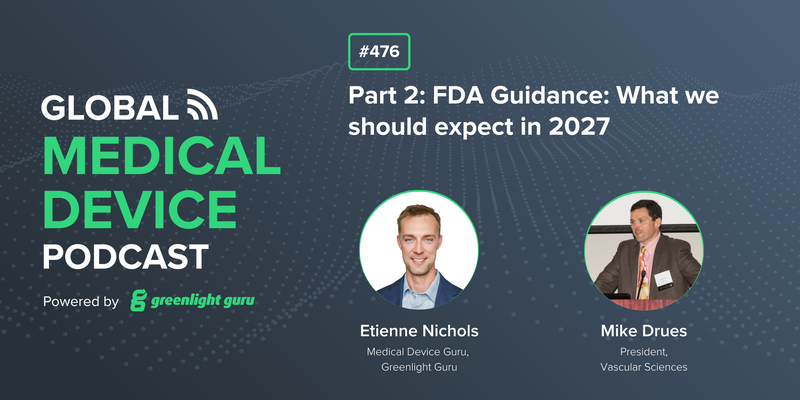
In this episode of the Global Medical Device Podcast, host Etienne Nichols continues his conversation with regulatory consultant Michael Drues, Ph.D., to examine the FDA's Center for Devices and Radiological Health (CDRH) guidance document priorities for fiscal year 2027. The discussion kicks off with a critical evaluation of the A-list, B-list, and under construction categories, analyzing the agency's timeline commitments and the practical realities behind how regulatory priorities are established and executed.
The conversation explores specific topics featured on the lists, ranging from AI-enabled device software functions and predetermined change control plans (PCCPs) to more traditional products like respirators and menstrual devices. Dr. Drues shares his perspective on the distinction between wellness devices and those intended for medical purposes, emphasizing the importance of reading between the lines of regulatory text.
Finally, the dialogue delves into broader structural questions surrounding FDA transparency, resource allocation, and how medical device professionals can effectively engage with the agency during the public comment period. Listeners are provided with practical insights on navigating evolving regulatory expectations and submitting comments before the November 30 deadline.
Watch the Video:
Listen now:
Love this episode? Leave a review on iTunes!
Have suggestions or topics you’d like to hear about? Email us at podcast@greenlight.guru.
Key Timestamps
- 00:00 - Introduction to Part Two: Overview of FDA guidance documents as current thinking and context from Part One.
- 03:34 - Parsing the A-list, B-list, and Under Construction categories: Understanding CDRH's intent, resource constraints, and agency wiggle room.
- 11:09 - Deep dive into the FY 2027 A-list topics: AI software functions, PCCPs, surgical robots, and NIASH-approved respirators.
- 18:50 - Exploring the B-list priorities: Medical device user fees, pulse oximeters for medical purposes, and post-market cybersecurity.
- 23:39 - The continuous improvement model of regulation and the under construction list.
Top takeaways from this episode
- Monitor the Guidance Lists: Review the CDRH A-list and B-list priorities early to align your R&D and regulatory submission timelines with upcoming FDA expectations.
- Understand Regulatory Intent: Recognize that placement on the A-list reflects CDRH's stated intent rather than a hard guarantee, meaning manufacturers must build flexibility into their regulatory strategies.
- Distinguish Medical Purpose from Wellness: When reviewing product codes and guidance, carefully evaluate how the FDA defines medical intended use versus general wellness to avoid unexpected classification hurdles.
- Participate in Public Comments: Take advantage of the public comment window open until November 30 to provide actionable data and feedback on guidance priorities that impact your specific device portfolio.
References:
- CDRH Guidance Document Database: The primary repository for published FDA draft and final guidance documents.
- Etienne Nichols on LinkedIn: Connect with host Etienne Nichols for ongoing medical device discussions and industry updates at Etienne Nichols' LinkedIn
MedTech 101 Section
Predetermined Change Control Plan (PCCP): Think of a PCCP like a blueprint for future home renovations that you get approved by your local zoning board all at once. In medical devices—especially software and artificial intelligence—a PCCP allows a manufacturer to pre-specify planned modifications to a device, such as machine learning model updates, and gain FDA clearance for those changes upfront. This prevents the manufacturer from needing a brand-new submission every single time the algorithm updates, streamlining continuous innovation while maintaining safety.
Memorable quotes from this episode
"When FDA takes a second look at products, especially that have been around for a very long time... it's usually because there have been problems. It's usually because there have been reports that show up on NBC six o'clock news, or there starts to be product liability lawsuits." - Mike Drues
"We don't live in a binary world. We don't live in a world where things are true or false, white or wrong, black or white. It's not simply a matter of, yes, I'm following cybersecurity requirements or no I'm not. It's in the gray area, the infinite number of shades of gray in between." - Mike Drues
Feedback Call-to-Action
We want to hear from you! Your feedback helps shape future episodes and ensures we bring you the most relevant regulatory and engineering insights in the MedTech industry. Please leave a review, share your thoughts, or suggest future episode topics by reaching out directly to our team at podcast@greenlight.guru. We personally read and respond to every message we receive.
Sponsors
This episode is brought to you by Greenlight Guru. Navigating complex regulatory landscapes like the FDA's fiscal year priorities requires a robust quality management system and efficient data management. Greenlight Guru's industry-leading Quality Management System (QMS) and Electronic Data Capture (EDC) solutions are built specifically for the medical device industry, helping you bring life-changing products to market faster and with total compliance confidence. Visit Greenlight Guru to streamline your design controls, risk management, and clinical data workflows today.
Transcript
Etienne Nichols: Hey everyone, welcome back to the global medical device podcast. My name is Etienne Nichols. I’m the host for today's episode, and I’d like to welcome you back to part two of our conversation with Mike Dreus on FDA guidance documents. If you missed part one, here's kind of the short version.
I’ll let Mike fill in the gaps that I leave out. But we talked about guidance documents and what a guidance document is and how it's the FDA’s current thinking, not law necessarily. you're allowed to take a different approach, but you'd better have the data to back it up. And you should expect that it's going to cost you some time. We talked about regulation versus guidance, who actually has to follow it, draft versus final, and where to find all of these things. So go back and listen if you want to get that foundation. But today we're going to get to the main event because on October 1st, FDA’s device center published its guidance priorities for fiscal year 2027. And its A-list that is A-list of what CDR plans to write over the next 12 months.
Some of its kind of what you'd expect. There's ai in there, there's PCCP, surgical robots. Some of it's more interesting, a few 510(k) topics. Maybe how you select a pred predicate on the under-construction list and so, I’m guessing that means the FDA hasn't made up its mind, but I don't want to get our head of ourselves, but we'll go through the A-list, the B-list, the under-construction list, and we'll ask how topics even get in these lists on the first place. What's missing?
And I know the question that I’ve been waiting to hear Mike on whether or not FDA should even be in the business of writing guidance documents at all. So, one thing to know before we start, FDA is taking public comments on this list until November 30th. So, something we say today matters to your topic to your product. We'll just stay tuned; we'll tell you exactly where to send those comments. So, thank you so much for being here, and Mike, how are you doing today?
Mike Drues: I’m very well, Etienne, and thank you for asking and by the way, I think that was a very nice sort of a recap of what we talked about in the in the first part of our discussion and I’m looking forward to continuing including the topic that you just mentioned and that is should FDA be in the business of writing documents.
Etienne Nichols: Yeah.
Mike Drues: But we'll get to that in a little while.
Etienne Nichols: Yeah, I have I have a tendency to get ahead of myself. So, I’ll try not to do that today. So maybe let's start with what can we expect for 2027.
Mike Drues: Yeah, great question. So, as you mentioned, FDA has put out, as they oftentimes do, and A-list and a B-list and an under-construction list to help us, you know, understand what to look forward to in 2027, the next calendar year. but I want to parse our words very carefully here.
FDA, specifically CDR said with regard to the A-list, it's priority guidance that CDR intends to publish in fiscal year 2027. Intends to publish. They don't say that we will publish them. They say we intend to publish them. And you know, it's a little frustrating with FDA because they never or they rarely ever say anything definitive, right?
They always and this is the lawyers that come out with these kinds of words. We intend to do this, or we intend to do that. But to me, Etienne, this is like asking, you know, the fire chief of your town, if God forbid, your house is on fire, what would they do? And the fire chief says, "We intend to put out the fire in your house. we won't say that we're going to put out the fire anyway."
Etienne Nichols: Right?
Mike Drues: Alright, and then similarly for the B-list, this is the guidance’s that CDR intends to publish as resources permit in 2027. I think that as resources permit applies to the A-list as well. So, when we parse the meanings of this word these categories very carefully, it's not easy, you know, let's put it this way.
FDA has allowed them or given themselves a lot of wiggle room. And when I share with you some statistics of how many guidance documents FDA has published in the past that have never in fact come out, I think you'll start to appreciate what I mean. And finally, there's this third category that you mentioned Etienne, which is the under-construction list. Well, first of all, as I think we talked about in the first part of our discussion, every guidance, whether it's final or draft or under construction, every guidance should be considered as under construction.
It's a work in progress. It's subject to change. But the according to FDA, the under-construction list is guidance documents that CDR intends to develop as resources permit. So that's the same as the B-list and that are not on the a or the B-list. So exactly how we're differentiating between the B-list and the under-construction list, to be honest with you, I don't really understand.
Maybe it's a distinction without a real difference. And if you can explain it to me, Etienne, then please do because as my wife constantly reminds me, I’m not always the brightest bulb on the tree. But I’m just, you know, trying to take the same critical approach of what FDA is saying than when I go to into the FDA as a company with my labeling and my testing matrix and so on and so on. So maybe this is a distinction without a real difference. And finally, Etienne, in terms of statistics, when we look at the current calendar year, fiscal year rather, 2026, CDR has published seven of the 11 guidances or 63 that was on the list last year.
Well, I don't know about you, Etienne, but I have taught at over 15 different universities at the graduate level over the years. I’m currently teaching at one ivy league university at the graduate level. 63%. I’m not sure that most students would be happy with that with that grade. And five of those seven that were published were on the A-list. Two of them were published on the B-list, which begs the question to me, if the A-list is the priority ones and the B- list are the less priority ones, then why are we publishing B-list guidances before we finish the A-list? I mean, again, I don't think these are, you know, difficult questions. I’m just trying to understand, and finally, and then I would love to hear your thoughts on this, Etienne.
CDRH has committed to finalize, withdraw, reopen the common period or issue a new draft guidance for 80 of the draft guidances within the next three years of closing the common periods and a hundred of them within five years of closing the common period.
Once again, resources permit I have no problem with that as resources permit disclaimer. Look what happened when you know during co, but quite frankly why the heck is this all taking so long? It's only the us government can spend so much time doing these seemingly simple things, and anyway, thoughts on any of that? I don't mean this to be personal. I mean many of my I have very good friends at FDA but look at the end of the day I consider myself to be a medical device professional and I’m responsible for what I do and what I don't do and I expect other people companies as well as the FDA to do the same.
Etienne Nichols: Yeah, I think it's interesting to think about those you were talking about the A versus B. So, it made me think when I was a product development engineer going out and asking someone to one of the guys to make a part for me and he said, well put it on the board. So, I went over there and I said, "You got priority one, priority two, priority three." He's like, "Yeah, just wherever you feel like it belongs."
So, like, "All right, you put it on priority three." because I’m like, I’m a lowle engineer. I go out there and it's been weeks and weeks, and I said, "hey, when?" He said, "Well, I don't know. I don't typically get to priority three if it's important, you know." So, he goes up and then he said, "Well, when do you get to get to priority two?"
He's like, "I don't know. I’ve never done one." So, it's not until it's priority one. So, it makes me think, you know, you're you talk about the different things that are potentially holding them back. And besides just the fact that it's government in general, but, the CDR, I don't know about how well it's rebuilt its staff back yet.
But even that aside, I do kind of wonder, you know, as you were talking, you made me think I wonder if there's going to be a future where, we're going to have an LLM versus these straight FDA guidances, but that's pure speculation.
Mike Drues: That's an interesting question, Etienne, and I would love to explore that perhaps in a different discussion. But to go off on the resource tangent for just a moment…
Etienne Nichols: Sure.
Mike Drues: I’ll be the first to admit that it has been a show, literally a show at FDA for the last several years. and many people have left the agency. Their headcount is down overall. And as the, you know, as the press would have us believe, they are making a conscious attempt to bring in more people to replace the people that have left.
Here's the problem with that, Etienne, and here's what FDA doesn't say publicly. The people that they're bringing in to replace the people that have left, the people that are coming in now are in general much less experienced and knowledgeable than the people that were there before, hands down. So, I think when we have and again this is a topic of a different discussion I think but just focusing on the number of employees at FDA is really not the right measure.
Etienne Nichols: Yeah.
Mike Drues: It's the experience level and the knowledge and the expertise of these employees. So, I just wanted to throw that out there. I’m fully cognizant of the challenges that FDA has, especially in, you know, after covid and after all of the bad press and so on and so on. But Etienne, and I would hope that you would agree, we as an industry have to talk about not just what we do well, but we also have to be willing to talk about what we don't do well in order to ultimately make our industry and indeed the world a better place. And that's other than the conversations that we have and a few other people have, that's not something that I hear a lot of people do publicly, unfortunately. I hear a lot of people say things privately, but they won't say the same things publicly, and that's a problem.
Etienne Nichols: Yeah. Well, when you're talking about this being you know, is this actually going to be what is going to happen next year? What I think of also is I think it's like kind of like a snapshot in time almost when you get your blood drawn at the doctor once a year, your annual visit, and it shows you a snapshot in time.
Hopefully, you actually fasted, you didn't have orange juice for breakfast, whatever it was. I think that's a similar situation here. But it doesn't mean it's not meaningless or not something worth looking at. So maybe we could just look at what the a-list maybe starting at what we consider to be the top from the from a surface level.
Mike Drues: Yeah, I want to get into the a-list as well, Etienne, but I gotta just add a tiny bit on your blood test metaphor because I love that metaphor. It's a snapshot in time, but once again, just like in regulation, in biology or medicine, we have to not overgeneralize. So, there are some biomarkers that will test in your blood that are in fact one measurement in time, like for example, your glucose level. However, there are other measurements regarding glucose, your a1c, for example: that is a measurement over the last two or three months.
So, anyway, just wanted to throw out there for all of my biomedical engineer friends, the audience. All right, so let's talk about the a-list from FDA for 2027. And I’m just going to go down the list really quickly. the first one, and this is an FDA’s order, not my order. The first one is (NIOSH) approved, that's the National Institutes of Occupational Safety and Health (NIOSH) approved air purifying respirators.
The second one is recommendations for ai enabled device software functions. The third one is for menstrual products. The fourth one is for the predetermined change protocol plan, the PCCP. The fifth one, maybe something near and dear to your heart, Etienne, QM, quality management system information for certain pre-market applications. Number six is robotically assisted surgical devices. And number seven is accreditation scheme for conformity assessment program.
So that is what is on the current publicly announced a-list, and on the a-list for the draft guidances, there's only one. We'll just talk about them collectively is generative ai enabled conversational devices for mental disorder and my question to that last one on mental disorders is which also applies to the other seven that I mentioned previously why is it these you know some of them are a little esoteric you know menstrual products I’m not saying that those shouldn't be updated but those have been around for a very long time respirators once again been around especially in light of co for a very long time.
I can think and we'll get to this in in a moment when we talk about you know what things that should be on the list that are not but I can think of other things that should be on the priority list that at least according to the information that we have is not so your thoughts on what's there Etienne?
Etienne Nichols: Yeah, I so it's a good question. I don't have a lot of opinion on it. I was curious if they do they give any kind of indication as to why some of these matter.
Mike Drues: It not in the same documentation that came out with the outs.
Etienne Nichols: Yeah.
Mike Drues: Now to be honest, I haven't done a thorough scrub scrubbing of FDA’s website or other sources. You may remember Etienne and in the first part of our discussion where I said we talked about where to find information about guidance documents.
Of course, I mentioned the guidance document database, which is a good resource, but the guidance document database only includes, you know, what comes out of the FDA. I suggest that I usually get my best information from a simple google search because that takes a much broader approach. So, to be fair, I can't answer that question definitively, but assuming that there is not an explanation out there somewhere, I think there should be.
Etienne Nichols: Yeah. Well, I just looked it up and this is an interesting statement. Why does CRDH post list of guidance documents? Let's see the ones.
Mike Drues: I'm guessing MDUFA requirement. You tell me if I…
Etienne Nichols: Yeah, MDUFA requirement.
Mike Drues: Yeah, but it doesn't really say why these exactly. it just says the FDA agreed to meet variety of quantitative and qualitative goals what so…
Etienne Nichols: I can't tell you and again I want to be crystal clear in saying things that I that I know are definitively true versus things that are my professional opinion. And by the way, after 30 plus years, my professional opinion is pretty good. I can tell you that when FDA takes a second look at products, especially that have been around for a very long time, like respirators and menstrual products and so on and so on, it's usually because there have been problems.
It's usually because there have been reports that show up on NBC 6:00 news or there starts to be product liability lawsuits and so on and so on. you know, bad news sells. Good news doesn't sell. So, again, I don't know if this is the case or not, but if there were have not been problems with respirators or menstrual products, I kind of doubt that FDA would be spending its limited resources updating that information. It's the same as you and I have talked about before, the guidance control guidance that goes back to what was the year 20 1997. And I’ve said many times FDA should not touch that guidance because even though it's 20 years old, it's still a really good, really broad guidance.
Mike Drues: Yeah, it's the thing that's interesting to me about this. I don't know. It's I’m there's two levels, you know, I could get into the interest in each individual topic, but at a Meta level, like why this, why that, you know, and but I agree. It's likely driven by something. I think I’ve said this in the past. I’ve always thought that history or regulation can be boring, but the history that put that regulation in place is rarely boring. So, I’m not sure. it's interesting.
Etienne Nichols: And I don't want to just, you know, be a whiner or a complainer. I want to offer pragmatic and possible solutions. One of the solutions that I’ve posed to the FDA multiple times and perhaps in some of our podcasts as well is I really love the us supreme court model and that is whenever they make a decision they publish both a majority opinion as well as a minority opinion.
We can follow the similar footsteps of the us supreme court here. When FDA comes out with a list of final guidance documents for 2027, have some explanation as to these are the ones that we plan on publishing and here's why. and oh, by the way, these are the ones that we considered or we discussed, but they're not on our priority list and here's why. and again, people talk all the time about transparency. well, to be brutally honest, i don't see a lot of transparency.
Etienne Nichols: What's interesting and then I love that you brought up the supreme court because uh it's tickling my brain back to the recesses. Loper Bright the Chevron difference overruling. You remember that? Where basically there was, I don't know I think it was like from the 80s where there was a precedent in the Chevron case back then that they had to defer to an agency's interpretation of their own standard and that was overruled in the Loper Bright.
I think it was just recently, like in the last couple years, 24, I think. So anyway, it's interesting because it's only I know it's only tangentially related to the topic we're talking about with guidance documents, but considering that is their current thinking on this matter or their interpretation of a guidance document, the fact that that was overturned in that Chevron case that in in a legal proceeding, they no longer have to use that the court doesn't have to necessarily defer to the way an agency interprets their own thinking. So, I think that's evidence that we as medical device professionals should have the same ability to have that ability to negotiate.
Mike Drues: It's a good suggestion as I'm not an attorney nor do I play on tv and I’m certainly not an a legal scholar so I’m not familiar with the details of that case. However, what I can say is that there were similar decisions, not a lot of them, but similar decisions over the years against the FDA where FDA had the court and I’m paraphrasing here said that, you know, you had to follow the standard or something like that.
Etienne Nichols: Yeah. Are you still there?
Mike Drues: Move on to the oh, sorry…sorry…yeah.
Etienne Nichols: Yeah, absolutely. Let's do it.
Mike Drues: Okay so, again, these are the b list guidance document topics for 2027 in order by FDA, and once again, they still have that time and resources disclaimer permitting disclaimer. Medical device user fee small business qualification and determination. Pulse oximeters for medical purposes, and by the way, you're you may be starting to notice I’ve seen this creeping up more and more in the different regulation, the different product code descriptions in here in the guidance. Pulse x approximators for medical purposes. Do you know why they're putting that phrase medical purposes in there, Etienne? Can you guess on that?
Etienne Nichols: I'm assuming it's for diagnosis, but not sure.
Mike Drues: Good guess, but actually not. Sorry, I’m sorry. good guess, but actually you're correct, and here's the reason to distinguish it from a wellness device.
Etienne Nichols: Oh yeah to.
Mike Drues: Distinguish it from a wellness device, which is a wellness device you can't use for diagnosis or treatment. At least they're not supposed to, and this is another example of as I talk to my customers and as I talk to my graduate students, you have to read not just what is what is said or what is written, but you have to read what is not said or what is not written.
I find most of the time what is not written speaks much more loudly than what is, and then finally, the last b-list guidance topic is the QUB program and specifically some of the changes that have been proposed under the last version of MDUFA that's supposed to go into effect I believe in October of next year and specifically I won't get it into here but there's a new presub option that will if MDUFA passes that will become available to companies.
So, those are the ones that are on the b list. The priority or sorry the final guidance b list and then the draft guidance b list. There are two: one is the device software function functions. This was used to be referred to as device software functions for mobile medical apps. So, they're just sort of re-titling that, and I think they're getting away from the emphasis of mobile medical apps because there's been a lot of confusion about that for a long time.
Why? I don't know. I think it's because people don't truly understand the actual definition of medical device and whether it's a piece of software or not makes no difference. And then finally, the last draft guidance under the b list is post-market management of cyber security in medical devices. And I find it interesting that again this is Mike Drues' opinion slash slash comment that why that is on the b list because cyber security is obviously a big thing and we've talked about cyber security in several occasions over the years.
While FDA admittedly has made progress in cyber security of medical devices I still think there's an awful lot of work that needs to be done. So, I’m glad that it's on the list. My question is why is it a B-list rather than an A-list?
Etienne Nichols: Yeah, I agree and I would expect that one's probably going to be one that gets published first just considering 524b that's cyber security is already required by statute. So, the expectations exist where the FDA writes some down about this or not. So, yeah, I agree.
Mike Drues: Just to follow up on that last point, Etienne, I have to, you know, we have to be careful. We don't live in a binary world. We don't live in a world where things are true or false, white or wrong, black or white. it's not simply a matter of yes, I’m following cyber security requirements or no, I’m not.
It's in the gray area, the infinite number of shades of gray in between. How well are you following them? And so on and so on, so again, not a criticism, but I just wanted to make sure that everybody remembers it's very easy for politicians or FDA or even us to say, "Yeah, we're following the regulation." Well, I think in the first part of our discussion, Etienne and I use the metaphor of let's say you live in a in an HOA and the HOA says your house has to be blue. Well, what exactly does that mean? So, that's the point that I’m trying to make here.
Etienne Nichols: Yeah, okay. What about the under-construction list?
Mike Drues: Yeah, so once again, and I can't emphasize this point enough, in my view, all guidance, indeed all regulation, including the code of federal regulations, is under construction. It's constantly evolving. it's constantly changing, and I would think, Etienne, that you as well as most people would probably agree with me on that. We don't want regulation that we write it down today; it will never change for a million years. I would not want to live in that kind of a world.
And to use the quality metaphor, continuous improvement. You know, we've written the regulation or the guidance today. We think it's pretty good, but it's probably not perfect, and we've written it to the best our ability based on what we know today, but tomorrow or next week or next month, we might some learn something new, and we might have to go back and rewrite it or adjust.
Similarly, when I was an R&D engineer many years ago, designing medical devices myself, it was very tempting to me to try to design the perfect medical device first time out of the box. But I realized that's very difficult if not possible impossible to do, and so what you do is you come up with one prototype version, you test it, you make changes, you test the next version, and so on and so on.
It’s very iterative product development is iterative regulation should be iterative as well. We also talked in the first discussion about draft versus final and how at least in my opinion those words should not be used because they just confuse people. So, specifically in the from the FDA the under-construction list again they have the same disclaimer time and resources permitting considerations of selecting a predicate device to support a pre-market notification also known as a 510(k).
Now you may remember Etienne that FDA just put out about was it couple i want to say about 3 years ago three guidances specifically on the 510(k) and two of them were directly and the third one was indirectly related to predicate selection and I believe we probably did a podcast on that topic back in the day and I’m not trying to be arrogant Etienne but I will point out that most if not all of the select of the recommendations that FDA made in those predicate selection guidances came right out of my pl playbook.
In other words, they were my sop for a very long time. The next one under construction is evaluation of thermal effects for devices that produce tissue heating and or cooling that's you know it's an important topic. Obviously as a biomedical engineer, I’m very concerned with biothermodynamics but you know why it's under the construction. I can think of a lot of other guidances that should be in that list as well, risk assessment and evidentiary considerations for generative ai enabled devices.
So, yet again we have another example of ai here, and finally, select updates for 510(k), specifically evaluating substantial equivalence in pre-market notifications, PRP, pre-MNs, also known as 510(k)s.
Mike Drues: And I find it fascinating that the 510(k) has been around since 1976, and the regulation itself, including substantial equivalence, has not changed. One word, one letter, one punctuation mark, yes, guidance has come out and there have been a litany of guidances over the last half century, but the statistic remains true to this day, Etienne, and that is that more 510(k)s today in 2026 are rejected because of substantial equivalence or the lack thereof than any other single reason.
So, my question is, does FDA or anybody else think that we're really going to solve this 50-year-old problem by putting out yet more guidance? I’m reminded of Einstein, very, very smart guy. Einstein said, "Insanity is doing the same thing over and over and expecting a different result." we seem to be doing the same thing over-and-over, putting out more and more guidance on substantial equivalence and expecting a different result. Maybe I’m getting old and I’m just a little cynical, but i don't think that's gonna solve any of our problems.
Etienne Nichols: Yeah, I don't know to me, it looks like it's one of the it's a two-way street. Is it the guidance? Is it the substantial equivalence the way they evaluate? Is that the problem or is it the way medical device companies try to make a substantial equivalence claim that's the problem? Who's in the wrong?
Mike Drues: It's all of the above. I think it's all of the above. Yeah, we have to all take some blame here. But I actually did my own little anecdotal study off the book study because I have personal relationships with many FDA reviewers. I came up with and I have to be a little careful what I say here, but I came up with a fictitious 510(k) device and sent a description and a regulatory strategy to about a dozen of my FDA reviewer friends and just basically asked them the question was this is this substantially equivalent to the predicate as I argued in this in this brief and it was about 6040.
Etienne Nichols: Oh wow, you know so it was absolutely not 100% you know agreed or disagreed. it was almost you know flip a coin. Yeah.
Mike Drues: So, again as a quality person Etienne, I tell people all the time don't assume that your quality system works just because you tick off the regulatory requirements. test it. Inject purposely some problems into your quality system and see if they are detected and if they're handled properly and if they're not detected or if they're not handled properly then you know that there's a problem right similarly here if we're talking about substantial equivalence or you know I’m just using that as an example you know test it see if we have consistency within a division at FDA or indeed across all of CDR because I don't think if we did that and I would love to see maybe some academic do this as a study and publish it. I don't think if we did that, I don't think i let's put it this way. I think many people including FDA might be surprised at the results.
Etienne Nichols: It makes me think again not to be a broken record, but I can't help but wonder if when you have objective or evidence of subjective, I guess results 6040 seems kind of pretty skewed. You know that's kind of like you said a to a coin toss. How soon how long will it take before ai and standardization through AI comes into play here?
Mike Drues: Well, this is another topic that we've talked about. and by the way, I would love to take a deep dive another deep dive in AI because I’ve my favorite one was the one that I think I did with john back in, I don't know five or six years ago where i basically told FDA that this concept of a locked algorithm was a was a chaotic concept or archaic concept rather.
But here's the thing to answer your question, Etienne. So, we have ai being used now on both sides. I have customers sending me documents that they plan to send to the FDA once it gets past me that they've admitted to me that all or a portion of this has been written by AI.
And I say to them, I don't know who the heck this AI person is, but they don't know what the hell they're talking about. They're smoking their socks. I would not submit you know any of this and similarly on the FDA side of the table there's been increased chatter in and I've been involved in some of this at FDA as well of FDA using AI tools to evaluate company submissions.
So, to take this is to the extreme Etienne, you know we're going to have companies using AI to write submissions with no people involved and we're going to have FDA using AI to review submissions with no people involved. I don't know about you Etienne but is that a world that you want to live in? i certainly don't. ai is great tool but it's not you know the end of the game.
Etienne Nichols: Yeah, it's interesting because I people hear use that or almost um it almost seems like the conversation stopper when people say, "Well, do you want a device that was used on your mom that was completely designed by AI?" and that's a great conversation stopper, I suppose. But I also I mean, you can flip it around and say, "Would you want a device that was completely designed by humans used on someone?" I’m like, "well, so I don't know."
Mike Drues: Yeah. you know what? your point is well taken, Etienne, and especially since I teach at the graduate level in engineering at an ivy league institution and i really question what we're teaching people anymore.
Etienne Nichols: Yeah, I really do. but the other thing I’d say about and not to go too far down this path, but we use something of a bait and switch when we talk about the LLMs and how poorly they can write because it's true, they have a weird way of writing and I don't necessarily agree that that's what I would want in a submission.
But there that's one-use case of writing. But there's also other use cases that I think are very interesting such as like a tolerance stackup which is very difficult for an engineer to wrap his head around. And I got to go positive and the negative and positive and negative whereas that should be something that should be very easy for an AI.
So, I mean it's kind of like use case and evaluating whether a predicate to get back to our topic is substantially equivalent. It depends on how those people come up with that you know the 64 or subjectivity if that's something that could be very easily done standardized across to say yes or no. I don't know this.
Mike Drues: And again, as I said before, Etienne, I’m not a lawyer, but I’m sure in the legal world, there are there are many examples where you show the information to one jury and they come up with one opinion. You show the same information to another jury, and they come up with a different opinion. So, you know, taxes are that way. you know, there's lots of examples. Why would anybody think that the medical or the regulatory world would be any different?
Etienne Nichols: Well, why don't we go why don't we talk about the how topics get on these lists? We talked a little bit about the AB-list that likely a MDUFA commitment and I think is it FDORA—the Food and Drug Omnibus Reform Act of 2022. I know that's where PCCP’s and cyber came from that at least that's why they seem to be so important for so long. but what how do topics get on these lists in your mind and…
Mike Drues: Yeah, yeah. So, how do topics? Well, first of all, let's take a slightly broader approach at the beginning first, and that is let's talk about new guidances in general, whether they're a priority or not. I’ll get to that in a second.
Etienne Nichols: Sure.
Mike Drues: So my favorite example of new guidance is and again as we talked about in the first discussion we have to be a little careful about overgeneralizing when we use the phrase guidance documents because some of them are a little more policy oriented like how do you do a presubmission meeting or how do you fill out a 510(k) application and some of them are more technology oriented like for example you know devices that admit heat or cold you know to the patient or rf energy or something like that.
Primarily what I’m talking about here is the latter category, the technology guidance documents. and one of my favorite examples is the drug alerting stent guidance. Technically, the drug alerting stent is a combination product. It's not a device although it is a device-led combination product, but here's why I use this as a metaphor.
In the interest of full disclosure, I was one of the principal architects on the first two drug alluding stances that came through the FDA and onto the market. At that time, there was no drug alluding stent on the market and there was no drug alluding guidance on the market either. In fact, Etienne and think about this it was not until six or seven years after we got the approval of the first drug alerting stent that FDA published the first drug alluding stent guidance.
So, this is just another example of how I often say that regulation in this case guidance is backwards looking. It rarely is forward-looking and I that gets us into competitive regulatory strategy and the fact that because there was no guidance on the drug stent when I brought the first two drug stances onto market, I viewed that as a huge advantage because I didn't have the baggage of what other people may have done before me to overcome.
So that's one example another example is if on the on the policy side, if we have new FDA policy, we mentioned earlier that one of the guidance is expected to come out as a result of, MDUFA 2027 is the update on the presubmission guidance because among other things, it will or at least it should include information on this new presub option that companies are going to have now as of next fiscal year assuming that everything that MDUFA 27 goes through and of course that has not been approved yet.
Another example is in incomplete guidances, you know I mentioned earlier that no guidance or any regulation should be final because we're constantly learning more and more information. So, for example, if there are missing tests that are not in a current guidance, and my favorite example here, Etienne, is to refer to the Philips Respironics class action lawsuit, the largest class action lawsuit in the history of the medical device industry.
In the interest of full disclosure, I was one of the key expert witnesses in that case that led to AI believe a $1.3 billion dollar that's billion with AB settlement, and one of the many things that changed on the FDA side was that FDA dumped a whole bunch of additional tests into the guidances that were applicable to those kinds of ventilators and CPAP machines and so on and so on that were not there before.
In my opinion, they should have been there before as a biomedical engineer, there was nothing surprising. But unfortunately, you know, sometimes you have to, as they say, TE touch the hot stove before you actually get burnt. Yet another reason why regulation is backwards looking rather than forward-looking.
And finally, the last two quick thing is if you have guidance that is ambiguous or confusing, then that's an opportunity for FDA to go in and kind of clarify or clean up things, and finally, as I alluded to earlier, sometimes there's a sense of urgency. So, for example, going back to the drug stent guidance, why did FDA wait six years until after the first two dees products came out? They knew that we were had these in the pipeline. They don't why don't they go ahead and prophylactically issue some guidances sooner than even before the devices or the combination products come out. So those are some you know I can think of others perhaps you can as well Etienne but that's some of how these guidances come to be just not just for the B-list and the B-list priority but more importantly from a from a broad perspective.
Etienne Nichols: Yeah, and I you I know you've probably kind of alluded to it, but it is possible to anyone can actually propose a guidance document under I think it's 10.115. I looked this up a little while ago 21 CFR part 10.115 actually has the address to send it marking the document guidance document submission submitting to documents management staff so…
Mike Drues: FDA is conly saying they want constantly saying they want our feedback. so that's a great way to give them feedback.
Etienne Nichols: Yeah, and I think the comments up until November 30th if you want to comment on what's going on out there right now. So, what's not on this list though? You've talked a little bit about like okay this should you know I can talk about a few things that are so what are things that are on your mind that you feel like should be on this list.
Mike Drues: Yeah. you know what Etienne because I know that we're coming close to the end. We could go through that I can give you many suggestions that I think should be on that list. However, I would argue that we've done that already you may remember that we've done podcasts, for example, on the ECRI lists that have come out over the last several years and how ECRI has identified, you know, their top 10 problems that the medical device industry has faced.
They've been doing this now, I think, for what was it 20 years or something like that. So, why doesn't FDA take a look at that list and see or listen to our podcast and see, well, here are some problems going on. Maybe some of these are worthy of having a guidance or at least a discussion about having a guidance. So, we could use time in this podcast, Etienne, but I think we've already done a lot of that already.
Etienne Nichols: Yeah, okay. Well, any suggestions for the FDA then I guess that's that is your suggestion then. sounds like listen to what we've talked about in the past.
Mike Drues: Yeah. So, a couple of things. First of all, and I may have mentioned this in the first discussion with regarding to searching the guidance document database. You can search by keywords, but you're only limited to keywords in the title of the guidance. So, if you use the word angioplasty, you're only going to come up with one guidance because apparently, and this was a surprise even to me, the word angioplasty is only in the title in one guidance, but it won't pick up if PTCA is in the title.
And PTCA is percutaneous trans luminal coronary angioplasty, but because the word angioplasty is not in there, it won't pick it up. And more frustrating, it doesn't search the content of the guide. It only searches the title. I’m sure that my computer friends, my database savvy friends, you know, they can come up with much more elegant tools that we can do comprehensive databases, full document searching rather than simply title searching, that's one specific recommendation. another suggestion again similarly along the lines of the angioplasty is maybe add suggestions on other search terms to use. you know you've referred to AI.
Well, I think what we're doing now with ai today quite frankly from a biomedical engineering perspective is laughable compared to what we could be. So, if you go to the guidance document database and you do a search for angioplasty, why not have a little popup come, you little AI popup say, "Hey, I noticed that you're interested in angioplasty, you might consider searching similar terms like stenting or atherectomy or something like that…that would be a terrific a fabulous way of using AI which right now we're not doing to be fair.”
It's not FDA’s job to tell us how to find this information. It's our job, but I would love you know whatever help that that we can get on that. One of the underlining assumptions is that the people that are doing these searching, for example, if you are working on an angioplasty balloon, you're already a subject matter expert in that area and you already know about stenting and atherectomy and bypass and all of the other things.
But the question is how many people do have that broad breath of expertise? You know, this is analogous to doing a traditional literature search in Medline, for example. your search is only as good as the terminology that you use. If you're not using the right terms or if you're not using all the terms that you should be using, then you know, garbage in, garbage out.
The guidance document database only includes the newest the published guidances, but it does not include the history of that guidance. What versions of this guidance came out be beforehand? I think I mentioned in the De Novo guidance there are five or six versions of the De Novo guidance and the last I want to say three or possibly four of them were stamped across final.
So it kind of begs the question, what does final mean if you're constantly putting out more and more guidance? And similarly, why doesn't FDA, you know, pay us the respect if they're going to update a guidance like the De Novo? Why make our make us waste our time parsing through the entire document to see what is the same and what has changed? Why not put a little sort of a summary at the beginning?
Hey, these are the things that have changed since the last guidance that way, we don't have to waste our time going through and, you know, finding out what we what's changed. I used to have graduate students do this for me because it's a very laborious kind of thing. and by the way, you know, the what's good for the goose is good for the gander. I do exactly the same thing with the FDA.
If I go to the FDA with a presub and let's say that this is a second presub that I’m doing on a particular device, I don't just regurgitate them the device description from the first presub. What I do is I say here are the changes that we've made since the first presub and then I'll also include the device description from the first presub as an appendix to the back of the presub.
That way, if you were not familiar with or not part of the first presub, you can read the entire device description. But if you were familiar with it already and you remember that previous device, you don't have to waste your time reviewing the entire thing in trying to pick out those one or two or a couple of things that have actually changed. So again, these suggestions I’m giving to FDA, I you know, i implement, you know, all of them my myself. and the last thing, well, well, anyway, that's probably a good place to stop at that point.
Etienne Nichols: Yeah, I'll just kind of add on to what you were saying because when I was thinking about what I would make suggestions, publishing a red line every time a guidance is revised would be very helpful. Yeah, I think that'd be better than even just a summary, but if you had the red line, that way somebody looking at the brand new one, they don't need to know what happened previously cuz they're starting with, you know, but if someone else would like to see what the previous one is, they go look that red line.
Mike Drues: By the way, Etienne, as a as a top quality guy, which I know you are, you think of a quality metaphor that explains exactly what you just described.
Etienne Nichols: Oh, yeah. it's just it's change control.
Mike Drues: Change document control.
Etienne Nichols: Yeah.
Mike Drues: Right, document control so again, we don't need more regulation. We've already got probably more regulation than we need. What we need is people understanding the regulatory logic, as I like to call it, and say, gee, how does document control apply to this conversation that we're having here?
Etienne Nichols: Yeah, that's I actually started to quote the 21 CFR part I guess it's part A20.40 document control, but now it's I guess ISO 1345 clause 4. But the other thing that I was going to say is putting a clock on the drafts. If a draft hasn't been finalized in 3 years, I think they should either finalize it, withdraw it, or explain why. so that's that's the other thing I would say.
Mike Drues: This is a discussion that we had at least 5 years ago, maybe 10 years ago. There was a discussion about making such a cap but unfortunately, you know…
Etienne Nichols: Yeah, okay, the question that I’ve been waiting for, and everybody's been waiting for. Should FDA be writing guidance? Is that their job? what are your thoughts?
Mike Drues: So once again, great question and again I don't want to overgeneralize so let me separate guidance documents into a couple of different buckets. One is this policy or procedure documents like for example you know the presub process or the contents of a 510(k) or clinical trial requirements or something like that.
I have absolutely no problem with FDA publishing documents like that to help to help us out for all the obvious reasons. However, the other bucket of documents, the technology, the engineering-oriented documents, things like biocompatibility, things like usability, things like electrical safety and so on and so on.
Do we really want our FDA to tell us how to test our product? I’m gonna be brutally honest with you, Etienne, and some people might not like this. if the people in the company, specifically the people that are not that are designing and testing, I’m talking about R&D, manufacturing, and even regulatory, if they don't know what the appropriate testing should be to show that their device is safe and effective, to show that their device does what they have on the label and so on and so on, then some people might think this is harsh, Etienne, but they should not be in this business.
It's as simple as that. now, we can use FDA’s suggestions as a backup, a sanity check to make sure that we haven't forgotten something. But it kind of begs the question, should FDA be in this business? After all, at the end of the day, the FDA does not design any devices. They don't under most circumstances test any devices themselves, right?
So, is this kind of the and by the way, many certainly not all, but many of my FDA friends have never worked in a medical device company. They have never been involved in designing or testing a medical device themselves. So, is this the proverbial, and I’m purposely trying to be provocative here, Etienne, is this the proverbial putting is this the proverbial blind leading the blind?
You know, if I wanted to learn how to do surgery, would i learn how to do surgery from somebody who has not actually done surgery before, but has read about it in a book? I don't know about you, Etienne, but I don't want that person cutting on me, right?
So, again, I don't want to be overly general here. In certain cases, in policy kinds of examples, you know, then I have no problem doing with FDA but in other cases, something to think about, and by the way, I’ve had FDA reviewers come to me privately and say to me, "Mike, if I’m going to be in the business of basically telling this company how to design and test their device, then why the heck am I up working at the FDA? Why don't I go out and work, you know, start a company and do this myself and probably make a heck of a lot more money?"
Etienne Nichols: Yeah
Mike Drues: So, this is part of, you know, what I consider to be professional responsibility. If I’m going to call myself a professional biomedical engineer, which i do, using that word professional comes along with it a certain degree of responsibility.
Etienne Nichols: Yeah, and I think that distinction between the administrative or policy as you put it versus the technical is important because I do think that the guidance documents around how to do some of these regulatory aspects is helpful but the real risk is really that that whole should turning into shall and I will say since Loper Bright in 2024 as I mentioned earlier courts no longer have to defer to agency interpretations of statutes. So that makes it even more important to keep those binding and non-binding requirements separate.
Mike Drues: Just one other thing I would add as an example and then we can wrap this up. Etienne and as you know and I think most of our audience knows I spend a lot of my time working as an expert witness in medical device product liability cases. Many of the cases that I’ve been involved with have led to very large settlements against the medical device manufacturer.
Why? because they did what was in the guidance. They did what the FDA required that was all they did in the area of biocompatibility, I’ve given examples where the company have should have done these additional things, but they didn't. In the area of usability and electrical safety and clinical trials and so on, I’ve made the argument that the company did what FDA told them to do. but as experts in this field, they should have been responsible. they should have known enough to do more. remember, as I’ve said before, Etienne, and when a company gets a 510(k), a De Novo, a PMA, when they get ISO certified, when they get a CE mark, when they follow what's in the regulation or the guidance, that's the academic equivalent of being a C student that doesn't mean that you're that only means that you're passing. Doesn't mean that you're necessarily making a safe and effective product. It certainly doesn't mean that you're making a good one. It only means that you're passing. something to think about.
Etienne Nichols: Well, thanks so much, Mike. I know we're kind of at time here, so I’ll just respect everybody's time. Thank you so much for being with us and appreciate you hanging in for this topic. If you have any questions, let us know. Love to hear what your thoughts are. I know Mike's interested in feedback from the audience. I am as well. so, you can find us both on LinkedIn or I’ll put links in the show notes that you can get a hold of us directly. until next time, thanks so much and we will see you then.
About the Global Medical Device Podcast:

The Global Medical Device Podcast powered by Greenlight Guru is where today's brightest minds in the medical device industry go to get their most useful and actionable insider knowledge, direct from some of the world's leading medical device experts and companies.