Many early-stage medical device founders face a major dilemma: how do you prove regulatory maturity to investors and partners before you actually hold a final CE mark or FDA approval? Waiting until the end of a long development cycle creates significant commercial risk. By treating regulatory readiness as a continuous maturity process rather than an all-or-nothing milestone, startups can build trust early and avoid costly late-stage surprises.
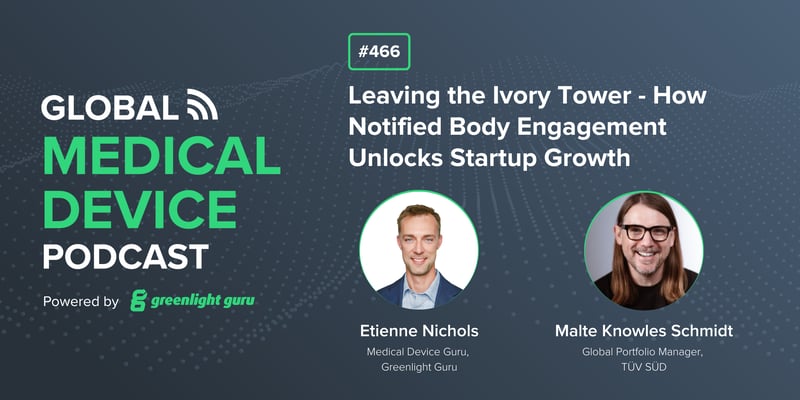
In this episode, host Etienne Nichols sits down with Malte Knowles Schmidt, Global Portfolio Lead for Medical Device Software, AI, and Cybersecurity at TÜV SÜD. Drawing from his background as an ICU nurse, an R&D product leader for Class III cardiac implantables at Biotronik, and now a notified body leader, Malte breaks down how startups can step out of their silos. He emphasizes that notified bodies and medical device companies must both "leave the ivory tower" to establish practical, real-world communication long before a formal audit occurs.
The conversation explores concrete strategies for demonstrating regulatory maturity during development, including standing up an enterprise Quality Management System (eQMS), securing partial ISO 13485 certification for core design processes, and leveraging external testing as strategic "breadcrumbs." Malte also cautions founders against chasing "Pyrrhic certifications"—winning regulatory approval at the cost of commercial viability—and shares practical guidance on when and how to initiate early structured dialogues with notified bodies.
Watch the Video:
Have suggestions or topics you’d like to hear about? Email us at podcast@greenlight.guru.
Listen now:
Love this episode? Leave a review on iTunes!
Have suggestions or topics you’d like to hear about? Email us at podcast@greenlight.guru.
Key Timestamps
- 00:00 - 02:15 | Introduction to the "Regulatory Ivory Tower"
- Etienne introduces guest Malte Knowles Schmidt and sets up the challenge of proving regulatory maturity early in the startup lifecycle.
- 02:16 - 05:04 | Why Communication Gap Exists Between Startups & Notified Bodies
- Malte discusses why structured dialogues often feel too abstract for founders and why concrete examples are needed to make early engagement approachable.
- 05:05 - 08:30 | Defining Regulatory Maturity & The Agile QMS
- Exploring how investors view regulatory progress, why build-measure-learn mindsets belong inside a QMS, and how an eQMS acts as a foundational framework.
- 08:31 - 12:10 | Unlocking Value Through Partial ISO 13485 Certification
- A breakdown of how certifying core design and development processes early builds commercial credibility and attracts investor funding before full scope audits.
- 12:11 - 16:45 | Leveraging External Testing & Avoiding "Pyrrhic Certifications"
- How penetration testing and biocompatibility act as evidence breadcrumbs, plus the trap of sacrificing commercial viability just to get a certificate.
- 16:46 - 20:30 | When and How to Initiate Contact with a Notified Body
- Practical advice for founders on overcoming the fear of reaching out, preparing essential homework (intended purpose, risk classification), and taking the first step.
Top takeaways from this episode
- Establish Early Regulatory Breadcrumbs: Investors want to see continuous progression. Utilizing an eQMS, conducting third-party testing (e.g., penetration or biocompatibility testing), and mapping regulatory roadmaps provide tangible proof of maturity long before final approval.
- Consider Partial ISO 13485 Certification: Startups do not need to wait for full scope certification. Certifying core design and development processes first demonstrates organizational discipline and can unlock major funding rounds.
- Avoid the Pyrrhic Certification Trap: Do not sacrifice your core business model or reduce critical product capabilities solely to make certification easier. Always align regulatory strategy with ultimate commercial viability.
- Treat Your QMS as an Agile System: Quality management is not a static set of restrictive rules; it is an iterative framework that should evolve alongside your product and team processes.
- Initiate Dialogue Early: Notified bodies are accessible for preliminary discussions. Reaching out early helps validate your intended purpose, risk classification, and submission assumptions before sinking capital into the wrong pathway.
References:
- White Paper: Leaving the Regulatory Ivory Tower by Malte Knowles Schmidt (TÜV SÜD).
- ISO 13485 Standard: Quality management systems requirements for regulatory purposes in the medical device sector.
- Host LinkedIn: Etienne Nichols on LinkedIn
MedTech 101 Section
- Pyrrhic Certification: Named after King Pyrrhus of Epirus, whose army won a battle against the Romans but suffered devastating losses in the process. In MedTech, a Pyrrhic certification occurs when a company successfully gets a medical device certified, but had to compromise so many features, intended uses, or commercial claims during the process that the resulting product has no real value in the market.
- Notified Body: An independent organization designated by an EU member state to assess whether a medical device complies with applicable regulatory standards (such as EU MDR) before it can be placed on the European market. Think of them as accredited referee agencies that verify safety and performance.
- Partial ISO 13485 Certification: Instead of waiting until an entire company, manufacturing line, and distribution network are fully operational to get audited, a company can undergo a certified audit specifically for a limited scope—such as its initial design and development processes.
Memorable quotes from this episode
"A Pyrrhic certification comes from a Pyrrhic victory, where you win the battle, but the losses are so great that the victory is basically meaningless... startups make the certification their core goal and not the commercial success." - Malte Knowles Schmidt
"If you're asking yourself the question, 'Should I be talking to a notified body?'—then stop right there, because the answer is yes." - Malte Knowles Schmidt
Feedback Call-to-Action
We love hearing from our listeners! Did this episode change how you view early engagement with notified bodies? Do you have questions about implementing an eQMS or navigating partial ISO certification?
Send your thoughts, topic requests, or guest recommendations directly to podcast@greenlight.guru. We read every message and respond personally to our community!
Sponsors
This episode of the Global Medical Device Podcast is brought to you by Greenlight Guru.
Navigating the regulatory landscape requires a solid foundation built on quality and clear clinical evidence. Greenlight Guru provides the only dedicated eQMS (Quality Management System) and EDC (Electronic Data Capture) platform purpose-built for medical device and software-as-a-medical-device (SaMD) companies. Whether you are aiming for partial ISO 13485 certification, setting up your first design controls, or running clinical trials to collect vital regulatory breadcrumbs, Greenlight Guru helps you scale efficiently while keeping you audit-ready. Learn more about how Greenlight Guru's modern QMS and EDC solutions can accelerate your path to market at www.greenlight.guru.
Transcript
Etienne Nichols: Everyone, welcome back to the Global Medical Device Podcast. My name is Etienne Nichols. I'm the host for today's episode and today I want to…we're calling this episode Leaving the Regulatory Ivory Tower. And this is based of a white paper, “Leaving the Regulatory Ivory Tower.” How early notified body dialogues reduce business risk.
So just to introduce this idea, here's a question.
You know, a lot of early-stage MedTech founders wrestle with. How do you prove you're serious about quality before you actually have a certificate to show it? You're not fully certified yet.
You might not yet be, but investors, they want assurance, partners want assurance. And a notified body eventually wants evidence, more than just a promise, but, but actually evidence that you have that quality. So, what actually counts as evidence of regulatory maturity while you're still building?
Well, my guest today has spent his career on both sides of that question.
Malte Knowles Schmidt started as an ICU nurse, moved into R and D and product work on Class III cardiac implantables at Biotronik, and now runs the global portfolio for medical device software, AI and cybersecurity at TÜV SÜD.
Part of his job has been getting the notified body out of the ivory tower and into the room with startups meeting when meeting them where they actually are.
So, we're going to talk about what regulatory maturity looks like in practice. Partial ISO 3045 certification and eQMS as proof, potentially. And the breadcrumbs that show you that you know what you're doing long before the full audit.
So, let's get into it. Malte, how are you doing today? Great to have you with us.
Malte Knowles Schmidt: I'm great. Thank you so much for having me. And it's, yeah, it's always a little, a little awkward to hear yourself being presented to somebody, to an audience, but I very much appreciate it and I very much like being here.
And yeah, leaving the regulatory ivory tower, that is a type that is pretty close to my heart because as you, as you said, I worked on both sides of the, of the spectrum I want to call it. And yeah, one of the things. So, I spent a lot of time basically as a product manager, head of products, like always busy trying to figure out where is the value that you can bring to a customer.
And yeah, yeah, back in the days we always called that, yeah, we need to leave the ivory tower. We need to call; we need to talk to our users. We need to get in touch with reality.
And that's sort of also where that, where the title came from. You said the notified bodies need to leave the ivory tower. Fair enough. I think both sides probably need to leave the ivory tower a little bit to, to, to have a check in with reality.
And that's what that title is supposed to, supposed to mean. Basically. Don't just do that with your users.
Try to try to get evidence wherever you can, wherever you can sort of validate your assumptions. And these assumptions in that case would then be the regulatory assumptions.
Etienne Nichols: Yeah, it's. And I want, I want your take on what that actual regulatory. Ivory tower is your definition or what does it mean to leave the ivory. Right. Ivory tower of the regulatory.
So, I think the phrase, I looked it up a little bit. I think it's from the early 1800s. A French poet wrote something about an ivory tower. He was basically saying, if you can't just sit in an ivory tower and write about the world, you have to go experience the messy world.
And I think, you know, I'll just use that as maybe an intro. You go ahead.
Malte Knowles Schmidt: Absolutely. Yeah, that's very. I didn't know that that's the origin of it, to be honest. But yeah, that's. But that's exactly what it means. And I think in the past that ivory towers or multiple ivory towers have been built and we now need to sort of relearn perhaps a little bit of the relationship between notified bodies and startups in that particular case so that we are.
Yeah. That we're not afraid maybe if I want to use that word, to talk to each other and to just have that check in with reality.
So, starting to let these towers and not think about what, what, what could be basically, but actually have a conversation and see what, what is reality.
Etienne Nichols: Yeah. Well, how do, how do you see that happening and playing out in real life?
Malte Knowles Schmidt: Yeah, I don't think it's happening really well, to be honest. So far, that's a broad and general statement and I'm sure there are exceptions where it's working perfectly fine.
But since a bit more than two years, I've been working on the notified buddy side, I'm realizing basically that the conversations that are being promoted, that should be had are not being had. I don't know if that's grammatically correct to say it that way, but you hear notified buddies, for example, a lot, saying, hey, you should reach out to us as early as you can. You should, you can always talk to us.
And then things like structured dialogues are being thrown around. And in my perception, that is just way too abstract. Like what, what, what is a structure? What is a structured dialogue?
Like, what does that mean? When a notified body tells me I can talk to them anytime, does that mean they have a little lock file where they ever, like where they write down all the questions, I'm asking that I'm still not really sure about, like what is going on.
So again, this is a broad statement, but that's just my personal perception and I thought it's very important that the changes and that we give concrete examples of how these converse look like, because in my, in my, in my perceptions, these discussions are not happening as much as I think would be valuable for both sides, basically.
So that's, yeah, that was basically the base thought of that white paper. And it gives a few examples.
Obviously, that's not exhaustive, but a few examples to make it much more concrete and be like, hey, you know what, if this is a question you have right now, pick up the phone and you can talk to us.
And this is, it's as easy as that.
And yeah, and then obviously there can be, there can be a bit more, a bit more structure to it or a bit more of preparation for these conversations and things like. But this is something that you can learn once you establish the initial conversation and once you learn that people that work in the notified body ivory tower are also just humans that might wonder what the reality looks like to some degree.
Etienne Nichols: Yeah, yeah. So, I'm curious, so if we go back. So, we talked a little bit about the phrase of the regulatory, you know, I've tower for what about regulatory maturity?
Because I think that's important to think about as well. And maybe I'm getting a little ahead of myself because I mean, maybe another question would be why, why are we starting this conversation now and what is it that's relevant about it right now versus, you know, 10 years ago?
Anything. Has anything changed?
Malte Knowles Schmidt: 10 years ago?
I don't know. Maybe we could say probably, yeah. I mean, maybe, yeah. What has changed? The investor landscape has changed. Maybe not 10 years, but a few years in the past.
If we look at that then the investor landscape looked much better than it does today. For example. And when we talk about regulatory maturity, one of the things that I always found extremely painful is that everybody is sort of aiming towards and waiting for that CE in Europe for that CE certification or the FDA approval so you can finally sell your product and the investors are looking for that.
And some investors might not even get into the game before you have that. And it's.
But it seems like such a, such a long desert road, if you want to say so that you need to cross.
So, the question we asked ourselves and something that I also tried to investigate a little bit more, did some research on how can you, how can you build a path towards that CE certification or that FDA approval or whatever market you want to go to first that sort of leave bread crumbs that leave steps that show that your company actually has regulatory maturity, that it's not something that is, it's not just the certificate or the approval that is relevant, but it's also like, have you hired people that know what they are talking about? Have you hired quality people?
Have you hired regulatory people? Or are you working with consultants or how do you, how do you sort of fill that void?
Have you for example, started working with the QMS? Like even if that's, even if you have not had full certification or partial certification of that QMS, are you already working towards building a quality management system?
Because that shows that you sort of building yourself or building rules for yourself that start to ensure that you're building a medical device that you know that you're not, you're in a different game, you're not building an e-commerce platform.
I worked in quite some startups where a lot of people came from the e-commerce side, for example, and the assumption was like, yeah, let's build, measure, learn, let's kick product out and then let's learn along the way. And that's obviously a great mindset.
But at the end of the day, like if you don't do that within a quality management system, if you don't sort of bring yourself or if you don't play within the rules of the medical device game, then that shows that you might not from a regulatory perspective that you might be not as regulatory mature.
So having an eQMS, for example, could be a good place to start. Yeah. And then you could develop from there.
Etienne Nichols: So, I love, I love the points that you made there. So, we're talking about regulatory maturity because that is a…I really like that concept, that idea of maturity versus you know, if you take it as a person or growing something or building a house, you build a foundation, you build the structure, you, you're not zero, just land.
And then suddenly a house or a building, you're. There’re steps along the way that, that are milestones that are. Yeah, go ahead.
Malte Knowles Schmidt: Yeah, sorry.
Etienne Nichols: No, no, I could see you jumping up a bit and I want to know what you had to say.
Malte Knowles Schmidt: Yeah, yeah, because, because everybody keeps talking about agility and yeah, you need to be flexible and all of these things, but that actually means, I just said, yeah, build, measure, learn. And that's a different game. But at the same time, the concept is what you, what you should still be doing. I mean, what you're doing is you, you come up with an idea, you come up with a, with a hypothesis.
And you need to validate this hypothesis to see do you have a business case, is your regulatory pathway working or even when you build, when you build your quality management system like a hypothesis might be, okay, this is the best way and that we can think of right now to get high-quality product fast out of the door.
That's a hypothesis. But at the reality, you might learn that your signature process is actually killing you because if somebody's on vacation, then you, then you don't ship product.
So, you, you develop a product in an agile way, in an iterative way, but you also develop yourself as an organization and as a foundation. I would see the quality management system as such something that you keep iterating, something that you keep shaping towards your needs.
Etienne Nichols: Yeah, I think a lot of startups assume that it's all or Nothing. You're either ISO 3235 certified or you're not. You've talked about partial certification. That was the third one. So, we have training and hiring QARA building and working with a QMS or an eQMS that really gives you that framework.
And I will kind of echo what you said, you know, building or utilizing an eQMS such as Greenlight Guru or whatever you may use. It gives you that, that framework that you now are, you know, in engineering we don't always like constraints in real world, but constraints are helpful in engineering because now you know where we can play. And I think it's the same with regulatory and it actually allows you a little bit more freedom once you know where the boundaries are and you've drawn those.
Now we can have the freedom to go as, as, as creative as we want within the inside that. Now it sounds a little counterintuitive and if there's anyone's out there listening and disagrees with me, I'd love to hear your feedback and because I'd love to have that conversation, but the other thing you said was partial certification. I want to talk a little bit more about that. What, what? Because I know about the stage one, stage two audit and ISO 1345 certification as a lead certified auditor myself.
But I'm not as familiar with this idea of partial certification. So, talk to me about that.
Malte Knowles Schmidt: Just a short disclaimer. I'm not the super pro on this, but I, I, I can give you, I, I can give you, I can give you a taste of, of what that means.
So, a lot of, a lot of companies think what you said.
It's an all or nothing decision.
I can only get a certification once I have it all in place, once I had checked all the boxes.
But you can also get a partial ISO 1345 certification, which means, and that's usually the typical road for companies that do that, that you take your processes for design and development and have them certified first.
So, you take that and that means that in itself already shows a great step towards regulatory maturity because these are your core processes.
And while you might be, while you might be also working on these processes, you can't, you can get a certification so you being audited once a year.
And the process in general works like a regular, like a regular certification but just with a limited scope that you can already work in that you can learn and then later on a year, maybe two, whatever, later on you get the full scope certification and then later you can get an MDR certification or FDA approval, whatever it is.
And what that like I think the phrase or the title, so to say regulatory maturity really, really shows that that's where it's at because you are mature enough to start working in that fashion and then you learn along the way.
So, you really grow up as a company me in that, in that sense. And that's something that is very valuable.
Etienne Nichols: Yeah. Okay. Man. It's been too long since I've been in the, the ISO 1345 certification world because I, this is coming back to me, but I'm, yeah.
So okay.
Malte Knowles Schmidt: It's also something, something nobody talks about really. Like there's so many, there's so many really interesting insights that if you understand them and if you want to talk to a notified body like this is one of the dialogues in that, in the white paper, for example, talk to us about other notified bodies of course as well about how they can support you with that regulatory maturity and then understanding how that can help you in your business success.
How can that help you with investor communications? And I talked to one startup and they got, I think it was 15 million if I'm not mistaken, funding based on their 13.5 certification.
So, it is something that you can use, but it all depends obviously on the story that you're telling and the pathway. But if this is like a logical, if you can show that there has been a progression and that's just the next logical step, then they can really help you.
Etienne Nichols: Yeah, no, that makes a lot of sense. So, so when a company does this, what do you think does talk to me a little bit more about standing up a quality system early on?
Is that something that they can really start to utilize in the process or is it something almost. I mean, I'm trying to sit here thinking, trying to imagine myself, I was just listening to this.
Okay, well, we could put up a quality management system, but I don't want to restrict us to too soon yet. You know, maybe I can hear someone saying something like that.
You know, we're still in the R&D phase. We want to move fast. We don't want to have change control on everything.
What are, what are some of the objections you can hear maybe coming to with this?
Malte Knowles Schmidt: Like, like these are very good objections that you already brought up. And me being a product person at heart myself, like in general, I also don't like rejection restraints. I don't like that.
I want to be free moving.
But when, when, when.
How do you say that? When push comes to shove, like at the end of the day, like, what really matters is that you actually do that step. And what I think is really valuable and what I experienced is if you build a quality management system, you don't have to get the certification right away.
Maybe we pause that for a minute.
But if you build a QMS and if you work with the QMS, make sure that you understand what your business goals. Is the product team in the room, is the marketing team in the room, is the regulatory quality tech team in the room.
When this is being designed and they are need, like what are the needs that you're putting that you, that you're optimizing that on? Is that moving to market fast with high quality or is it, I don't know. Does the quality management system become a goal in itself, like an internal reference that everybody follows but nobody knows? What is the external reference that you're actually trying to aim for?
And I think that the earlier you do that and if you start small and lean and then grow, I think the better you're off at the end of the day. But I totally get it. I totally understand that you don't want these restrictions from the get-go. But I still think there might be a middle ground.
Start with a core process and then restrict yourself a little bit and then see how that can grow.
I don't know if I answered your question now, but I may be about to lose power. Just time out. If I do, I'll come right back. Just. Okay, give me just a second here.
My apologies for this time out because I have something working out there. I just realized that they may be switching overpower. I'm sorry.
Malte Knowles Schmidt: Okay, I'm gonna pause the recording.
Etienne Nichols: All right. Apologies for that. I had a kind of a technical difficulty. They're switching overpower. And I don't know if I've told you this. I actually live completely off grid.
And so, we had to.
We're working on getting actual power. So anyway. Okay. Terrible. When you work with remote recordings all the time. We were talking a little bit about how an eQMS fits in, how you can do partial.
Partial certification through ISO 1345. But the other thing that I was curious about was some of the testing that might be relevant, needed for a certification. What are your thoughts there?
Malte Knowles Schmidt: Yeah, totally. I mean, yet again, that is just another breadcrumb along the way that you can, that you can use until the certification.
There are more breadcrumbs after the certification, so maybe we can dive into that as well.
But yeah, I mean, anything that shows, anything that gives you credible evidence that can be a conversation with a notified body, because you, I don't know, you've checked your regulatory roadmap, for example, like that could be a breadcrumb, or you discussed your intended purpose and your risk classification with the notified body.
That can be a breadcrumb because…or with the FDA for that matter, because it comes from a…from an entity that is not a consultant, that is not within your company.
And a test, an external test can, can be, can be similar evidence. Like if you do, if we talk software, I don't know. You do. You do a penetration test, and you don't do that in house. You don't do that. Your best friend is not doing that. But, but you're, you're trying to find. You're trying to find a partner who can do a penetration test for you that, that has, that has a certain credibility, perhaps that can also be.
There can also be a breadcrumb along the way or biocompatibility testing or whatever testing you might need for certification or market approval that shows you haven't done the whole thing, but you've done a few steps at this point.
You might have ISO 1345 certified QMS that you worked on for two years maybe or worked with for two years. You have your first tests done, maybe your clinical study is already done. There could also be another breadcrumb or whatever it is. So, you, you, you build a case, you build, you build basically a whole story around it.
And yeah, testing, to answer your question, can be another one of those.
Etienne Nichols: Yeah, I love that. So, it's almost like depending on who you want to be doing each one of those tests, you could potentially borrow from their reputation, borrow from their credibility.
If it's a well-known notified body like TÜV SÜD, for example, we've used them, we've used these others for their testing. So yeah, if an investor is familiar with those, they say, oh, okay, I know them. It's an easy check mark.
Yeah, yeah.
Malte Knowles Schmidt: I mean, it's just you and me talking right now, nobody listening. So I can talk openly.
And like, I mean, one of the things, one of the, yeah, one of the, one of the ways people see us as an organization to suit might be there. They're, they're a bit more strict or they're very, they're very German and they're very, I don't know, they're very, they're TÜV SÜD.
And we thought about like, okay, this, this is a brand that we have and how can we use that to our advantage and obviously to the advantage of our customers?
And one way was like, yeah, through these breadcrumbs. Because then if you're talking to an investor and even if it's just a dialog that you're having with us, you can say, yeah, I talked to TÜV SÜD and they, they, they didn't have any objections to the things that we're planning or they did the testing.
So, this is where, where we thought this, this could actually create value for, for, yeah, for customers basically, or for anybody else.
Etienne Nichols: Yeah, really lubricate those conversations well. So, I'm thinking of a, if, if I'm a founder who's pre-certification, I'm not there yet. I'm watching my Runway. I don't want to; I'm watching my burn rate.
What would you say is some of the smallest set of things they can put in place that genuinely signals maturity and starts putting all those things out without paying for processes that they don't really need yet.
Malte Knowles Schmidt: I don't think I want to answer that in a, in a, in an overall sentence or in an overall way, because I think it's can be quite, quite different depending on who your investor is.
Etienne Nichols: Yeah, that's fair.
Malte Knowles Schmidt: So I think, I think start having a conversation with your investor of like, what they would think that could signal that and then sort of maybe make that a bit of a negotiation and, or see who you want to target to become your investor.
It could be as simple as joining a training or having a freelancer who is a good, who worked at a notified body or something like that. For your regulatory, to build your regulatory system.
That could be a simple, a simple step. But I would also advocate to not only just do something for the sake of the investor, of course that's very relevant, but try to see what, what actually brings you value, what helps your organization to develop as well. So, it's very, it's very, yeah, it's very individual. But one thing could actually just be talking to a notified body or having, having a pre submission meeting with the FDA or something like this. That also shows already, like here are our assumptions and by the way, these are the assumptions that we already verified with, with the notified body or the FDA.
Etienne Nichols: How do you know when you're ready to talk to a notified body? Because we've talked about some of these conversations.
Yeah, yeah, I, I'm, I can see an investor or maybe a physician founder who has an idea, some patent, you know, money put into place. But he's like, I just feel dumb talking.
I don't know.
Malte Knowles Schmidt: Yeah, yeah, yeah.
If you ask yourself that question, that's probably the answer already that you feel the need to talk to somebody. And if you feel the need, then there's a reason behind that.
And yeah, you and I just talked about the fact that we have kids, so you get a lot of questions. But sometimes when my kids come to me, and I'm not comparing our customers to kids or anything just for the record, but sometimes I'm like, okay, I give back some, some questions like, okay, why, why don't you try to figure that out on your own first? Or why don't you? I feel like you're asking me a question, but you haven't done your research first.
So, the worst thing that can do that can happen. You feel like you want to talk to a notified body, do it.
The worst thing that can happen to you is that the notified body says okay to have a meaningful conversation with you. It would be great if you could figure out A, B, C, the typical ones.
What is your intended purpose?
What is your justification for your risk class? Have you thought about your regulatory roadmap? Have you talked about your clinical roadmap? Things like that might be the first, the first things that come back to you.
But that already is a learning that okay to build Something meaningful. This is something that I should. That I should work on and. Yeah, and once you've done that, then re-initiate that conversation. So, the worst thing that can happen is that a notified body tells you, okay, to have a meaningful conversation, you need to do your homework. And your homework should be ABC.
Yeah.
Etienne Nichols: Yeah. It's kind of like when you're in college and you go to the professor afterwards, he's like, I want to get an A. But I'm like, well, here's how you get an A.
Malte Knowles Schmidt: Yeah, that's true. Yeah.
Etienne Nichols: So, okay. We called this episode, “Leaving the Ivory Tower.” I'm curious if you want to go kind of full circle, because one of the things we were talking about is the notified body meeting startups where they are and curious if, if you're getting closer to the goals that you're. You're after with that and if it may be maybe backing up upstream of that. What are the goals with “Leaving the Ivory Tower?”
And if you want to speak just a little bit more to that, because I am curious more to hear about that.
Malte Knowles Schmidt: I mean, it's.
I think there are multiple goals, but the overarching goal is to build.
Coming from a startup thought, what is the overarching goal that you have? It is to build a commercially successful company.
Your goal is not to have a certification or a market approval. That is a step, but your goal at the end of the day is to be successful in the market.
There's something that's a phrase or a word I sort of initiated in that white paper, a little proud of something that I call a Pyrrhic certification.
And a Pyrrhic certification is. It comes from a Pyrrhic victory where you win the battle, but the losses are so great that the victory is basically meaningless. And that is what happens sometimes or oftentimes when startups think about a certification, they. They make the certification their core goal and not the business success or the commercial success.
So, they reduce the risk class, they reduce the features, they reduce the commercial claims and all of these things, and then they get a certification and everybody is happy. But it's a Pyrrhic certification because it's. It's not really meaningful in terms of creating commercial success.
And that's to bring it full circle. I would say this is the core goal, and this is. This is obviously the core goal of every startup. To be commercially successful.
And to leave the ivory tower basically helps you along the way. And the whole meaning of that is to support you, to ask you. The right questions and to guide where we. Where we are allowed, because obviously we're not allowed to consult, but to bring in the guardrails that we mentioned earlier to make sure the guardrails are understood along the way for. For startups and companies in general to be commercially successful.
Etienne Nichols: Yeah, okay. No, that makes sense. And I love that definition. Tell me the word again. How do you spell it?
Malte Knowles Schmidt: Pyrrhic. Yeah, it's a bit of a. I think it also comes from the Greek.
I think it has some Greek context to it. So, it's P, Y, R, R, H, I, C. Pyrrhic.
And so, there are Pyrrhic victories. And I. Because this. Yeah, this is a top. Yeah, this is. Again, this is something that happened to me or that happened while I was writing this white paper because I was so desperate to look for this for.
Because this is. This is a. This is a situation that happens a lot. And this is also being discussed on LinkedIn quite a bit. Everybody's like, yeah, how can you be more commercially successful?
And things like this.
But, yeah, a Pyrrhic certification, basically phrases. Frames that very well. That. It's like you have the certificate, but you're missing the commercial traction.
Etienne Nichols: Yeah, yeah. Pyrrhic. Okay. It comes from King Pyrrhus, an old Greek leader whose army won a battle but lost so many men he could not win the war. I think that's.
Yeah, you should be proud of that. That is.
Malte Knowles Schmidt: I am.
Etienne Nichols: I am.
And for those of you who are curious about.
I already mentioned this. I know, but if you're curious about the white paper that we keep referring to, we'll put a link in the show notes so that you can find that directly and read it because, yeah, the.
Obviously has some gems.
That's great.
Any last piece of advice that you would give those out there who are still kind of you know, pondering the. The path forward, how to leave those breadcrumbs. Yeah, yeah.
Malte Knowles Schmidt: I mean, this is clearly something I could talk about for hours. And I do that. There will be some webinars coming up and things like that.
Just like if you're asking yourself the question, should I be talking to a notified buddy, then stop there, because the answer is yes. And then initiate the conversation again. The worst thing that happens to you is you will get a list of homework, but then you already know more than you did before.
So just leave that ivory tower.
Etienne Nichols: Yeah, absolutely. That's awesome. Leave the ivory tower. Perfection. There's no need to go ahead, get out into the messy world. So, I love all the analogies and things that we've discussed.
Usually, we're in acronyms in this world, but I prefer analogies and or metaphors. I don't know. I guess maybe metaphors is the right word. Someone will correct me out there and if there's someone out there who's interested in this topic, wants to learn more, you can reach out directly to Malte. Reach out directly to me. Leave any comments feedback.
Love to hear that. Whatever thoughts you might have.
Where can people find you?
Malte Knowles Schmidt: Malte on LinkedIn is the easiest obviously. But also feel free to go to the link that we I think share in the show notes and yeah, then you, then you'll find the white paper but then you will also find access to more content into more things.
So, this is in general like there shouldn't be any secrets.
Yeah, yeah, yeah.
Etienne Nichols: Very cool. Awesome. Thank you. I look forward to maybe our paths crossing in real life in Germany one day. I'd love to come over there sometime, but we'll see one day.
Malte Knowles Schmidt: I mean the first time we met I think was in Copenhagen and I started at TÜV SÜD. So yeah, let's. Yeah, maybe, maybe sometime again. Yeah.
Etienne Nichols: Awesome. Well, thank you so much for joining us for the conversation. Really appreciate it. Really, really appreciate all the work you're doing at Tucson and look forward to seeing how it, how it goes and where it goes.
Until then, we'll let you all get back to it. Take care.
Malte Knowles Schmidt: Bye.
Etienne Nichols: Thanks for tuning in to the Global Medical Device Podcast. If you found value in today's conversation, please take a moment to rate, review and subscribe on your favorite podcast platform. If you've got thoughts or questions, we'd love to hear from you.
Email us at podcast@greenlight.guru.
Stay connected for more insights into the future of MedTech innovation. And if you're ready to take your product development to the next level. Visit us at www.greenlight.guru. Until next time, keep innovating and improving the quality of life.
About the Global Medical Device Podcast:
.png)
The Global Medical Device Podcast powered by Greenlight Guru is where today's brightest minds in the medical device industry go to get their most useful and actionable insider knowledge, direct from some of the world's leading medical device experts and companies.