THE 2027 QUALITY READINESS SUMMIT ON DEMAND

Solutions built for medical device teams to move faster, stay compliant, and grow with confidence.

Manage quality events, training, and documentation in one place.
Control documents, training, and change with traceability.
Track CAPAs, audits, and NCs with audit-ready records.
Qualify suppliers and manage parts with visibility.

Connect design, risk, and AI-powered traceability as you build.
Link needs, requirements, and verification to design controls.
Automate traceability from dev tools for faster releases.
Assess ISO 14971 risk as requirements and tests evolve.

Oversee studies with connected data, documents, and workflows.
Capture compliant clinical data with a validated medical EDC.
Plan and manage PMCF aligned to EU MDR expectations.
Collect clinical outcome data in-person or remotely on any device.

Built with regulatory insight to help medtech teams move faster with confidence.

Find issues faster and make smarter decisions with less manual work.

Tools and resources that help teams implement quickly and meet requirements.


1–2 full-time hires saved
Two founding engineers and a part-time quality contractor manage work that would otherwise require additional full-time employees.
|

Duplicate compliance work eliminated
Design requirements, traceability, and reviews are maintained as engineering happens, rather than documented in a separate process afterward.
|

Peace of mind under regulatory scrutiny
An established, validated eQMS gives VitaPixel confidence in its quality processes without the burden of building, validating, and maintaining its own system.
|

Less manual work as the company grows
APIs and AI automate routine tasks, connect quality data to other business systems, and reduce administrative overhead.
|
VitaPixel is a Philadelphia-based medical device startup developing the VitaPixel SVS, a software-enabled ophthalmic imaging system that brings the stereoscopic 3D view from a slit lamp to display glasses. By allowing clinicians to sit upright rather than hunch over the instrument, the system aims to improve the way ophthalmologists examine patients. It upgrades existing slit lamps rather than replacing them.
Founded by retinal surgeon Dr. Christopher Riemann, Tom Meyer, and Austin John, VitaPixel operates with a small team managing both hardware and software development. Tom brings 15 years of medical device experience, including helping bring two Class II ophthalmic devices through FDA clearance. He leads mechanical engineering and quality management, while Austin, the company's CTO, leads technology and software development.
As VitaPixel advances through design controls and toward commercialization, it must maintain the documentation, traceability, risk-management records, and approvals required of a regulated medical device manufacturer.
The FDA's Quality Management System Regulation (QMSR), which incorporates ISO 13485:2016, establishes requirements for controlled design and development processes. For a device combining mechanical, electronic, and software elements, that means keeping design requirements, reviews, risk records, and approvals aligned as development progresses.
For VitaPixel, the challenge was meeting those requirements without building the kind of large quality organization traditionally associated with medical device development.
For VitaPixel, the biggest cost of quality management isn't software. It's time.
Tom has previously managed paper-based quality systems that required a quality manager, document coordinator, engineers, and project managers to prepare, route, approve, and file records. Every engineering change and sign-off created additional administrative work.
Today, VitaPixel handles quality with two founding engineers supported by, part-time independent quality and engineering contractors. Tom manages mechanical engineering and its associated quality work, Austin handles software and its documentation, and their contractors provide independent review and oversight. They get to focus on the work that matters most, while compliance runs in the background.
With Greenlight Guru, VitaPixel has saved 1–2 full-time hires while maintaining design controls and progressing through design reviews.
Instead of spending that additional headcount on quality administration, the founders can direct more of their time and resources toward engineering, prototyping, and bringing their device to market.
Tom has seen how traditional quality systems can turn regulatory compliance into a second workstream. Engineers design the device, make decisions, and complete their development work. Then they spend additional time recreating those activities in quality documentation.
That approach doesn't just waste time. It defeats the purpose of design controls, which are intended to identify problems and maintain control throughout development, not reconstruct evidence afterward.
With Greenlight Guru, VitaPixel has made engineering and compliance one process.
Design requirements are maintained and approved in the system as development progresses. When Tom needs to confirm a specification during CAD modeling, such as the device's adjustment range or diameter requirements, he can search the design controls and retrieve the approved requirement in seconds.
When the team prepares for a design review, it generates current user needs and design requirements from Greenlight Guru. Traceability is maintained throughout development, so the team isn't scrambling to reconstruct the design history at each milestone.
Flexibility was a key reason VitaPixel chose Greenlight Guru over other quality management solutions.
Rather than forcing every record into a generic document structure, Greenlight Guru lets the team configure document types and numbering schemes appropriate for different records, including protocols, reports, SOPs, forms, and work instructions.
VitaPixel also rewrote its SOPs to describe how work actually happens inside Greenlight Guru, allowing for a smooth and clear process without extra steps. For related SOPs, hyperlinks directly to those controlled documents are included in the procedures to make compliance easy to follow.
For a design review, the team creates the review in Greenlight Guru, automatically assigning it a controlled number, routes it for review and electronic sign-off, then releases meeting minutes that reference back to the design review with signoff record. . The process produces the controlled evidence the team needs without an additional workflow outside the QMS.
One engineering process. One controlled record. No duplicate documentation.
That flexibility is particularly valuable for a lean team managing evolving hardware and software requirements. The QMS supports the way the engineers develop the device instead of creating another process they have to work around.
VitaPixel has the technical expertise to build its own eQMS. With today's AI development tools, creating that software is increasingly possible. But building a system is only the beginning in a highly regulated, always changing environment.
The founders understand the work it would take - they would also have to validate it, maintain it, and revalidate it as it changes. Every hour spent doing that is an hour taken away from developing their medical device.
Greenlight Guru gives VitaPixel an established, tested, validated eQMS and a validation package, without the ongoing burden of building and validating its own quality management software.
For Tom, that peace of mind is a central reason VitaPixel is coming up on their third year with Greenlight Guru, with no plans of changing.
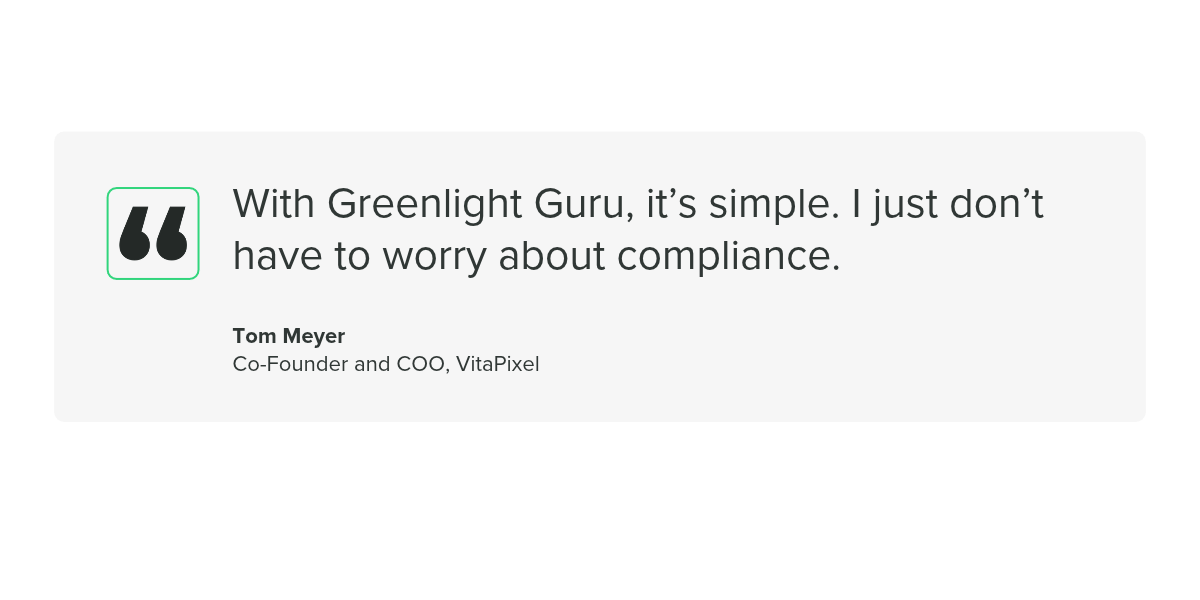
That confidence extends beyond the software itself.
Under FDA's QMSR and ISO 13485, medical device manufacturers need to demonstrate control over their design and development processes, including documented requirements, reviews, approvals, and quality records. Those records need to hold up when regulators or other reviewers examine how the device was developed.
With Greenlight Guru, VitaPixel's design requirements and traceability are maintained as engineering happens. Reviews and approvals are captured in the system, and its independent quality contractor has access to review records, sign off, and exercise oversight.
The team isn't relying on documentation assembled at the end of development or scattered across spreadsheets and folders. It has a controlled system of record supporting its quality processes throughout device development.